Home » A-Structure Tent as Emergency Replacement Buildings: Restoring Operations Without Waiting for Permanent Reconstruction
A-Structure Tent as Emergency Replacement Buildings: Restoring Operations Without Waiting for Permanent Reconstruction
October 8, 2026
When a natural disaster damages a factory, warehouse, retail facility, service center, or other commercial building, the immediate challenge is not always reconstruction. In many cases, the more urgent question is how to restore essential operations before the permanent facility can be repaired or rebuilt.
Fire, flooding, hurricanes, severe storms, earthquakes, and other catastrophic events can make an existing building temporarily unusable even when parts of the business remain operational. Equipment may still be recoverable, employees may still be available, inventory may still need to move, and customers may still expect service. Waiting for permanent reconstruction before addressing these operational needs can extend downtime and turn physical damage into a much larger business interruption.
This is where emergency replacement buildings can play a strategic role. Rather than replacing a permanent building in every respect, a temporary structure provides a rapidly deployable physical environment for the functions that need to resume first. The objective is to create a bridge between the damaged facility and permanent reconstruction, allowing essential activities to continue while longer-term recovery work proceeds.
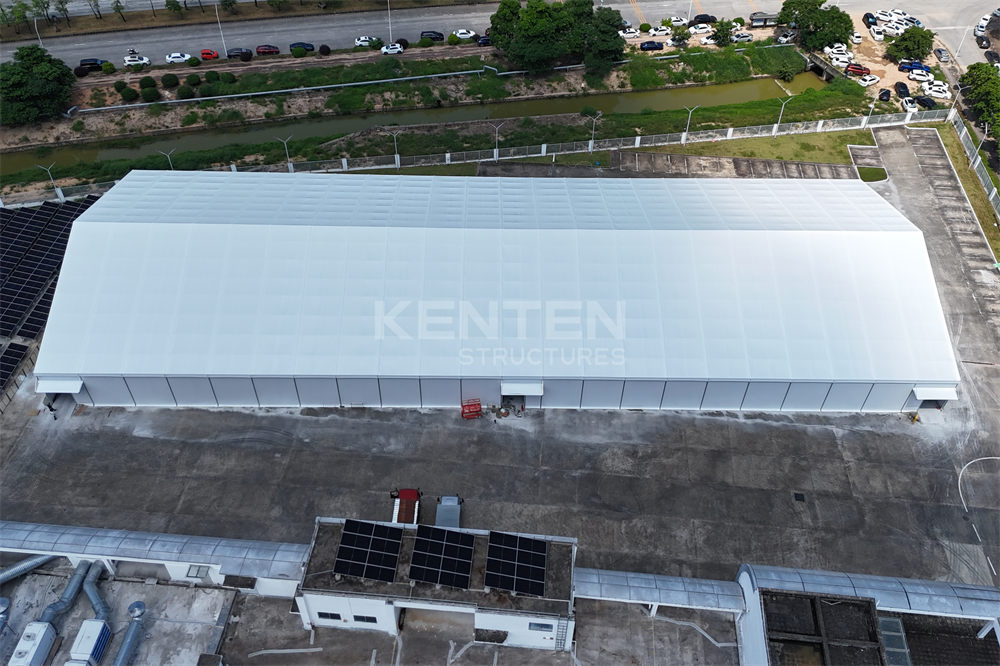
KENTEN A-Structure Tent provides a large-span, modular platform that can be configured for suitable emergency replacement applications, including temporary warehousing, equipment storage, maintenance operations, logistics support, and selected commercial or industrial functions. With clear-span space, adaptable enclosure systems, and project-specific engineering, it can form part of a recovery strategy designed around restoring operations without waiting for permanent reconstruction.
Emergency Response Is About Restoring Function, Not Rebuilding Everything
Immediately after a disaster, businesses often face two different timelines.
The first is the operational timeline. Customers still need products and services. Vehicles still need maintenance. Inventory still needs to be stored and moved. Equipment still needs to be inspected. Employees still need a place to work.
The second is the construction timeline. Damaged structures shall be assessed, debris may need to be removed, insurance claims shall be processed, designs shall be developed, permits obtained, contractors mobilized, materials procured, and permanent reconstruction completed.
These timelines rarely move at the same speed.
A permanent building may require months before it is ready for occupancy, while certain business functions may need to resume within days or weeks. KENTEN A-Structure Tent addresses this gap by providing an alternative space for critical activities before the original facility is fully restored.
A more effective emergency strategy is to identify which operations are essential, determine the physical conditions those operations require, and establish temporary space specifically around those priorities.
For one company, that may mean replacing a damaged warehouse. For another, it may mean creating a temporary vehicle maintenance facility. A manufacturer may need equipment staging and material handling space, while a distributor may need temporary receiving, sorting, and dispatch capacity.
Why the First Stage of Recovery Requires a Different Infrastructure Strategy
Traditional construction is designed around permanence. Emergency response operates under a different set of constraints.
After a disaster, the original site may be partially inaccessible. Existing utilities may be damaged. Ground conditions may have changed. Construction materials may be difficult to source. Local contractors may already be committed to other recovery projects. At the same time, the business may not yet know exactly how long the permanent reconstruction process will take.
This uncertainty makes flexibility particularly valuable.
KENTEN A-Structure Tent can provide an independent space while permanent decisions are still being made. It can allow a company to relocate selected activities away from the damaged building, create a controlled working environment, and reorganize operations around whatever portion of the business needs to restart first.
The value therefore lies not simply in speed of construction, but in speed of restoring usable capacity.
A warehouse does not become operational merely because a structure has been erected. It also requires suitable access, flooring or ground conditions, lighting, power, loading arrangements, fire protection, and an internal layout compatible with its storage and handling requirements. A maintenance facility may additionally require ventilation, equipment access, specialized utilities, and appropriate safety provisions.
Emergency replacement buildings should therefore be considered as functional infrastructure systems, rather than simply temporary tents.
KENTEN A-Structure Tent as Emergency Replacement Infrastructure
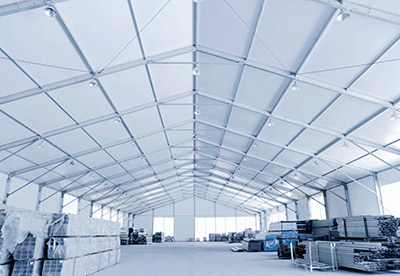
KENTEN A-Structure Tent is designed around a large clear-span structural concept that can provide substantial uninterrupted interior space for applications where internal flexibility is important.
For suitable projects, KENTEN A-Structure Tent configurations can reach clear spans of up to 80 meters and side clear heights of up to 15 meters, creating the potential for large operational footprints without a dense arrangement of interior columns. Actual dimensions and structural configurations are determined by project-specific requirements, site conditions, loads, and applicable codes.
This characteristic can be particularly relevant during emergency replacement projects because the temporary facility may need to accommodate assets that were never intended to fit within a conventional temporary building.
Forklifts need circulation routes. Commercial vehicles require sufficient turning and access space. Industrial equipment may require substantial clearance for installation and maintenance. Palletized inventory may need to be organized into temporary storage zones. The fewer fixed internal constraints there are, the more flexibility the business has when reorganizing these functions.
KENTEN A-Structure Tent can therefore be considered not merely as a covered area, but as a temporary operational platform around which selected recovery activities can be reorganized.
Temporary Warehousing When the Original Facility Is Unavailable
Warehouse damage can create an immediate operational bottleneck.
Even when inventory survives a fire, flood, storm, or structural incident, the loss of the warehouse can prevent the business from receiving, storing, sorting, and distributing those goods. Moving inventory into unsuitable outdoor or improvised spaces can introduce additional exposure to weather, security risks, and operational inefficiency.
KENTEN A-Structure Tent can provide an alternative covered storage environment where appropriate site, structural, fire, access, and environmental requirements can be met.
Its clear-span interior allows storage layouts to be developed around the company’s recovery needs. Pallet racks, floor storage, forklifts, temporary packing areas, and dispatch zones can potentially be organized within the same building.
The objective is not necessarily to reproduce the entire original warehouse immediately. A more practical emergency strategy may be to restore the highest-priority inventory flows first and expand the temporary operation as recovery progresses.
Emergency replacement is about restoring capacity progressively, rather than waiting for complete capacity to return all at once.
Temporary Maintenance and Equipment Facilities
Some businesses depend on physical equipment more than on the building itself.
Fleet operators, logistics companies, industrial contractors, equipment rental businesses, and manufacturers may still possess usable vehicles or machinery after a disaster, but their maintenance buildings may no longer be accessible.
Without a suitable covered workspace, these assets can become difficult to inspect, repair, prepare, or return to service.
A large clear-span KENTEN A-Structure Tent can provide space for equipment staging, inspection, maintenance, and parts organization where the proposed activities are compatible with the structure and applicable safety requirements.
Large entrances can be planned around vehicle or equipment access. Interior space can be organized into maintenance bays, parts areas, inspection zones, and circulation routes. Additional systems such as lighting, electrical distribution, ventilation, insulation, or HVAC can be incorporated where required by the intended application.
However, emergency deployment does not remove engineering requirements. Activities involving welding, fuel, hazardous materials, heavy lifting, or other high-risk processes require specific evaluation of fire protection, ventilation, structural loading, equipment foundations, and occupational safety.
Supporting Logistics When Distribution Capacity Is Disrupted
Disasters can interrupt logistics even when a company’s products remain available.
A damaged distribution center can prevent normal receiving and dispatch operations. Roads may be restricted, inventory may need to be moved between locations, and delivery schedules may have to be reorganized.
In this situation, a temporary structure can serve as an operational buffer.
KENTEN A-Structure Tent can be configured for suitable applications involving temporary receiving, sorting, consolidation, staging, and dispatch. Its open interior can accommodate changing operational layouts as logistics priorities evolve.
This can be especially useful when a company needs to create a temporary node between damaged infrastructure and functioning parts of its supply chain.
From Emergency Space to Operational Continuity
Emergency replacement strategy does not end when the temporary building becomes usable.
Once operations resume, the temporary facility becomes part of the company’s operational continuity plan.
KENTEN A-Structure Tent can create several possibilities.
The structure may remain in its original location while the permanent facility is reconstructed. It may later be reduced or reconfigured as parts of the permanent building return to service. If designed and approved for it, it may potentially be dismantled and relocated to another site when the initial emergency has passed.
This flexibility changes the economic perspective of temporary infrastructure.
The structure is no longer simply a cost incurred during a disaster. It can become a recoverable infrastructure asset whose usefulness extends across different stages of the recovery process, subject to its design, condition, transportation requirements, and future site approvals.
For companies operating multiple facilities, this concept can also support broader contingency planning. A temporary structure may form part of a predefined emergency infrastructure strategy, allowing the organization to respond to facility loss with a known structural solution rather than beginning the search from zero after a disaster.
Emergency Response vs. Catastrophe Recovery
Emergency response and catastrophe recovery are closely connected, but they solve different problems.
Temporary warehouse, workshop, office, production support, logistics facility
Key value
Reduce the initial operational gap
Reduce prolonged business interruption
Design priority
Rapid deployment and functional readiness
Longer-term usability, adaptability, and operational continuity
Engineering Considerations for KENTEN A-Structure Tent
Speed is important, but emergency deployment cannot come at the expense of structural suitability.
Every project should begin with an assessment of the site and intended use. This includes the local wind and snow conditions, seismic requirements where applicable, ground conditions, anchoring strategy, drainage, access, and the expected duration of installation.
For disaster-affected sites, ground conditions deserve particular attention. Flooding, debris, erosion, damaged paving, and unstable surfaces may affect the feasibility of installation. If the original site cannot safely support the temporary structure, an alternative site may be required.
The building envelope should also be selected according to the operating environment. Standard membrane systems may be suitable for certain storage or staging applications, while other projects may require more substantial enclosure systems, insulation, HVAC, or environmental controls.
Access is another critical consideration. Emergency replacement facilities often need to accommodate forklifts, trucks, construction equipment, commercial vehicles, or oversized machinery. Door locations and dimensions should therefore be developed around the operational flow rather than treated simply as architectural details.
Finally, applicable local building codes, fire regulations, permitting requirements, and occupancy conditions shall be evaluated before deployment. Temporary status does not automatically exempt a structure from regulatory requirements.
Building the Bridge Between Disaster and Reconstruction
Permanent reconstruction remains essential when a building has suffered major damage. Temporary infrastructure does not eliminate that requirement.
Its role is different.
It creates a bridge between the moment when an existing facility becomes unavailable and the moment when permanent infrastructure becomes operational again.
For businesses, that bridge can be critical. Every week of unnecessary downtime can affect inventory availability, customer relationships, workforce utilization, production schedules, and supply-chain performance.
A well-engineered temporary structure can provide an alternative environment in which selected functions resume while engineers, insurers, contractors, and owners address the longer reconstruction process.
KENTEN A-Structure Tent is suited to this concept because its large clear-span configuration can provide substantial operational space while its modular structure allows the facility to be developed around specific project requirements.
Conclusion: Restore Operations First, Rebuild for the Long Term
Natural disasters create a fundamental mismatch between the speed at which businesses need to recover and the time required to rebuild permanent facilities.
Emergency replacement buildings provide one way to close that gap.
By establishing temporary space for critical storage, equipment, maintenance, logistics, and other selected functions, businesses can begin restoring operational capacity without waiting for every stage of permanent reconstruction to be completed.
KENTEN A-Structure Tent can serve as part of this strategy where its structural configuration, enclosure systems, site conditions, engineering requirements, and applicable regulations make it suitable for the intended application. Its large clear-span interior provides flexibility for businesses that need to reorganize equipment, vehicles, inventory, and workflows within a temporary facility.
Ultimately, the value of emergency replacement infrastructure is not measured simply by how quickly a structure can be installed. It is measured by how effectively that infrastructure helps a business restore critical functions, reduce unnecessary downtime, and create a workable path from immediate disruption toward permanent recovery.
For organizations exposed to natural disasters and other facility-disrupting events, temporary infrastructure can therefore become more than an emergency tent. Properly planned and engineered, it can serve as an operational bridge between facility loss and business continuity.
FAQ
What is an emergency replacement building?
An emergency replacement building is a temporary facility established to provide essential operational space when an existing commercial or industrial building becomes unavailable because of fire, flooding, severe weather, earthquake, or another disruptive event. Its purpose is to restore selected functions without requiring the business to wait for permanent reconstruction.
CanKENTEN A-Structure Tent replace a damaged warehouse?
Yes. KENTEN A-Structure Tent can provide temporary warehouse space while a permanent warehouse is repaired or reconstructed. The appropriate configuration depends on storage loads, access requirements, site conditions, environmental protection, fire safety, and applicable building regulations.
CanKENTENA-Structure Tent be used for temporary equipment or vehicle maintenance?
Yes. KENTEN A-Structure Tent is suitable for maintenance and equipment-support applications when the structure and associated building systems are designed for the intended activities. Operations involving welding, fuel, hazardous materials, heavy equipment, or other specialized risks require additional engineering and safety evaluation.
How long can KENTEN A-Structure Tent remain in use?
KENTEN A-Structure Tent could remain in use for up to 20 years. The appropriate duration depends on the structural design, materials, environmental conditions, maintenance, local approvals, and intended use. A project designed for an extended recovery period may require more comprehensive enclosure and building systems than a short-term emergency facility.
Can KENTEN A-Structure Tent be relocated after reconstruction?
Yes. KENTEN A-Structure Tent is capable of dismantling and relocation when their design, condition, transportation requirements, and future site conditions permit. This possibility can be considered as part of the structure’s overall lifecycle strategy.


 HIGH-END SERIES
 STRUCTURE TENTS
 ACCESSORIES