Home » Atrium Structure Tent: Transparent Architecture That Transforms Any Venue
Atrium Structure Tent: Transparent Architecture That Transforms Any Venue
May 13, 2026
There is a moment every event planner and venue operator recognizes—when a space stops feeling like a tent and starts feeling like a destination. That moment is what the KENTEN Atrium Structure is designed to create.
Across North American and European hospitality markets, the definition of premium space has quietly shifted. It is no longer about square footage or shelter. Clients and guests now judge a space by how it feels when they step inside—whether it has atmosphere, whether it connects to its surroundings, and whether it leaves something behind after the event is over.
This article walks through how the KENTEN Atrium Structure delivers all three, using a real U.S. installation as the lens. Whether you are developing a golf resort, private estate, or corporate event program, what follows is a direct look at how this modular atrium structure outperforms conventional event infrastructure—and why more operators are choosing it.
Built for the Site, Not Just the Event
Most temporary structures are installed without much consideration for the surrounding environment. They arrive, they cover, they leave. The KENTEN Atrium Structure takes a different approach.
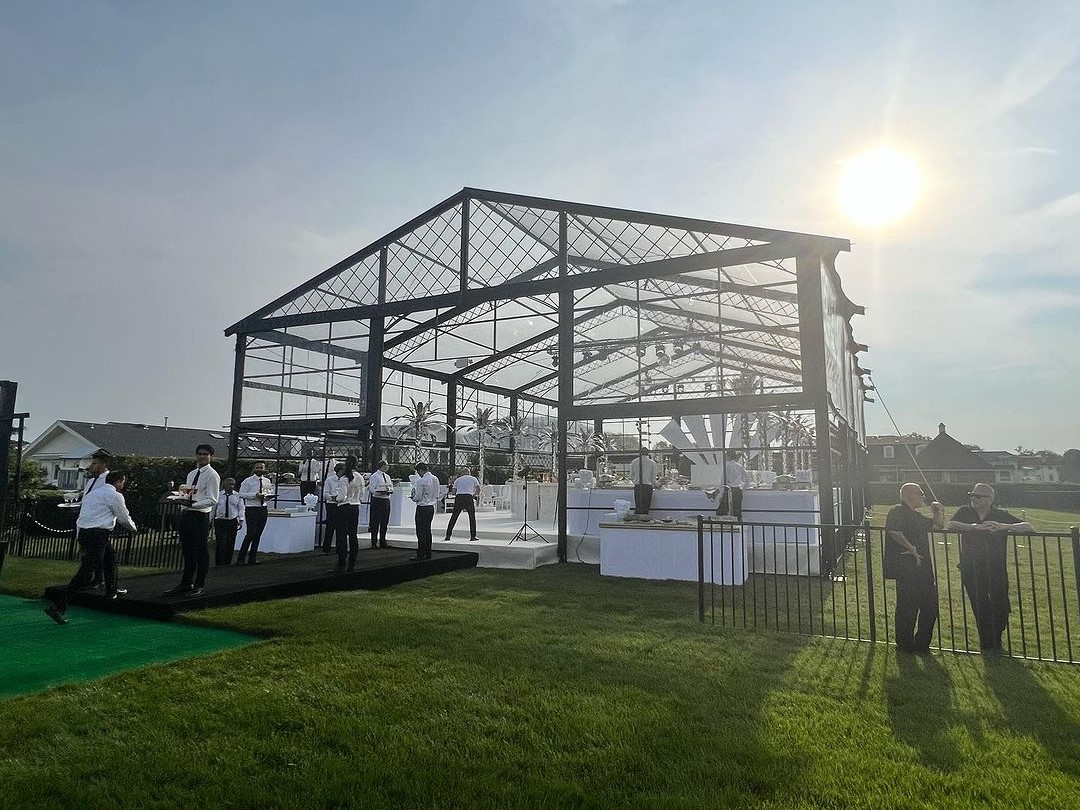
In this U.S. project—set within a property defined by manicured greens, classical architecture, and mature landscaping—the atrium is positioned to work with the site rather than interrupt it. The rectangular footprint aligns with existing pathways and planting zones. The transparent envelope ensures that views through and beyond the structure remain unbroken. From above, the geometry reads as a deliberate extension of the master plan.
This matters more than it might initially seem. In high-end hospitality environments—golf clubs, vineyard venues, private estates—the visual integrity of the property is core to the brand. A structure that looks out of place is not just an aesthetic problem; it diminishes the overall guest experience. The KENTEN Atrium Structure is engineered so that site compatibility is built into the design from the start, not managed around afterward.
The Transparent Roof: More Than a Design Feature
Ask any event designer about the difference between a great venue and an average one, and conversation quickly turns to light. The KENTEN Atrium Structure addresses this at the architectural level.
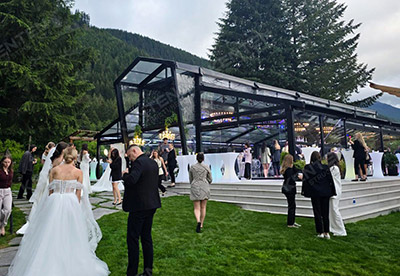
The fully transparent PVC roof is the defining element of this system. During the day, it effectively disappears—allowing the sky to become the ceiling. Clouds, shifting light, and natural atmospheric movement all animate the interior continuously. Guests experience the outdoors without being exposed to it. The result is a spatial condition that is genuinely rare:
Interior comfort without interior isolation
Climate control without visual enclosure
A boundary between inside and outside that feels perceptual rather than physical
As the day progresses, light shifts. Shadows from the structural grid move slowly across the interior. By late afternoon, the tone warms. By evening, the structure begins to glow from within. These are not effects that require any additional investment—they are part of what the transparent atrium structure delivers by default.
For operators running daytime and evening events in the same venue, this is significant. The same structure produces two different atmospheres, two different emotional experiences, without any physical modification.
Structural Refinement: The Discipline of Restraint
There is a principle in high-end architecture that is often misunderstood outside the industry: in premium environments, the structure that earns the most trust is the one you notice least.
The aluminum framework of the KENTEN Atrium Structure is engineered to this principle. Profiles are slender. Connections are clean. The structural grid establishes rhythm and order without dominating the visual field. The eye is free to move through the space, land on the event itself, and settle on the experience being created inside—not on the infrastructure supporting it.
This restraint is a technical achievement, not an aesthetic compromise. It requires precision in engineering to deliver structural integrity through minimal section sizes. For clients in premium markets—where every detail is measured against perceived value—this discipline directly translates into a higher-quality guest experience.
Interior Flexibility: A True Platform for Event Design
One of the most common limitations in temporary event structures is that flexibility is often theoretical. In practice, low load capacities, awkward geometry, and poor integration points force event designers to work around the structure rather than with it.
The KENTEN Atrium Structure is designed from the beginning to support real transformation. In the project images, the same interior adapts between:
Seated dining with overhead chandeliers and formal table settings
Open-plan receptions and social gatherings
Production-ready staging for performances or brand activations
What makes this work technically: the atrium structure supports suspended decorative elements such as chandeliers and floral installations, integrated rigging for lighting and AV systems, seamless flooring throughout, and fabric boundary elements to sub-divide space when needed.
Nothing feels retrofitted. The structure was designed with these uses in mind, so every integration point is already there when you need it.
Spatial Order and the Guest Experience
There is a quality in well-designed event spaces that guests feel without being able to name it: a sense of order and intention. Tables align naturally. Circulation is intuitive. Focal points are easy to establish.
This quality is embedded in the geometry of the KENTEN Atrium Structure. The centralized, axial layout that the system naturally supports creates visual balance and emotional calm—qualities that are essential in the types of events this structure is built for: weddings, corporate hospitality, gala dinners, and curated social experiences.
In premium events, perceived value is not just the sum of decorative choices. It is the result of spatial clarity—an environment that feels like it was thought through. The KENTEN Atrium Structure delivers that clarity as a baseline condition, not an upgrade.
The Arrival Sequence: First Impressions Are Architectural
How guests enter a space shapes everything that follows. The KENTEN Atrium Structure addresses the arrival sequence as part of its core design.
Large, transparent entrance doors open directly toward the landscape. From the outside, the interior is visible—luminous, active, inviting. From the inside, the exterior remains present—grounding the experience and maintaining the guest’s connection to the property they came to enjoy. This duality—defined threshold, seamless transition—prevents the structure from ever feeling like a barrier between the guest and their environment.
First impressions are not just aesthetic. They are architectural. The KENTEN Atrium Structure is built to make them count.
Day to Night: One Structure, Two Identities
As daylight fades, the character of the KENTEN Atrium Structure shifts. Artificial lighting—chandeliers, ambient uplighting, integrated fixtures—interacts with the transparent roof to transform the volume into a softly glowing enclosure. From the exterior, the structure becomes a beacon across the property. From the interior, the atmosphere becomes more intimate, more focused, and more emotionally resonant.
This dual-mode performance is a significant operational advantage. Daytime events benefit from natural light and openness. Evening events gain depth, contrast, and intensity. No structural changes are required between the two states—only light, timing, and design intent. For venue operators managing multi-day programs or transitioning between event formats, this is practical efficiency at an experiential level.
Where the KENTEN Atrium Structure Performs Best
Based on projects across North America and Europe, the KENTEN Atrium Structure is particularly well-suited for:
Golf resorts and country clubs looking to extend outdoor hospitality capacity
Vineyard and coastal venues where visual connection to the landscape is central to the experience
Private estates and destination properties hosting weddings and exclusive events
Corporate campuses and brand venues requiring a flexible, high-end hospitality infrastructure
In each context, the atrium structure acts as a strategic addition to existing capacity—enabling operators to host larger, more complex events without altering the permanent architecture of their property.
Rapid Installation, Reversible Footprint
Behind the refined visual presence is a system engineered for operational efficiency. The modular aluminum framework installs quickly, minimizing disruption to the surrounding property during setup and teardown. Foundations are lightweight and reversible, preserving the landscape and leaving no permanent impact on the site.
This makes the KENTEN Atrium Structure a practical solution for environments where:
Land use needs to remain flexible across seasons
Event demand fluctuates throughout the year
Long-term construction is not feasible, not approved, or simply not warranted
Deployed, it performs at the level of permanent architecture. Removed, it leaves no trace. This combination—installation speed, operational performance, and site reversibility—defines what the industry is beginning to call deployable architecture.
The Strategic Case for a Modular Atrium Structure
Beyond the event itself, the KENTEN Atrium Structure gives operators a different tool for thinking about their property and capacity.
Traditional expansion requires permits, construction timelines, and capital that is fixed once committed. A modular atrium structure offers a different model: scale capacity when demand is there, activate underutilized areas of the property, test new event formats without structural commitment, and adapt quickly when market conditions shift.
For operators managing premium hospitality venues, this flexibility is not just operationally useful—it is financially strategic. The KENTEN Atrium Structure becomes part of the business model, not just the event calendar.
The Result: A Space That Gets Remembered
The KENTEN Atrium Structure proves that temporary does not mean compromised. When a transparent atrium structure is designed with architectural intention—built for the site, engineered for flexibility, and refined to disappear into the experience—it produces something that conventional structures rarely achieve: a space that guests remember.
The fully transparent PVC roof makes the sky part of the design. The restrained aluminum framework keeps the focus on the event, not the infrastructure. The day-to-night performance gives operators two distinct venue identities in one deployment. And the modular foundation means the whole system can be in place in days, not months.
This is what the KENTEN Atrium Structure is built to deliver—and what this U.S. project demonstrates clearly.


 HIGH-END SERIES
 STRUCTURE TENTS
 ACCESSORIES