
Finding a reliable structure tent manufacturer feels harder than it should be. Search results are full of vague claims about quality without any real engineering detail. This guide answers the specific questions event planners, contractors, and venue owners actually ask before signing a contract — from certification requirements to realistic lifespan expectations.
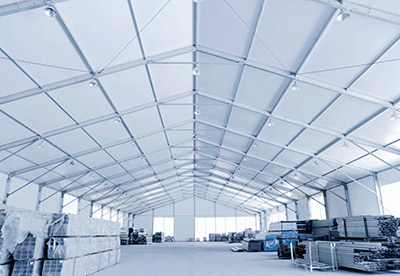
A structure tent manufacturer designs and produces semi-permanent or permanent aluminum-framed structures, not disposable party tents. These clear-span buildings serve as exhibition halls, sports venues, grandstands, and multi-level event spaces. The frame carries the entire load, so the fabric skin acts as a weather barrier rather than a structural element — a distinction that separates engineered structures from consumer-grade canopies.
Because an uncertified structure becomes a liability the moment weather turns bad. Building codes vary by region, and a tent rated for one country’s wind zone may fail under another’s requirements. Reputable manufacturers certify their products against recognized codes rather than relying on marketing claims alone.
| Standard | Region | Governs |
|---|---|---|
| IBC 2024 | United States | General building safety |
| CBC 2025 | California | State-specific structural code |
| ASCE 7-22 | United States | Design loads for various hazards |
| GB 50429 | China | Aluminum structure design |
| EN 13782 | Europe | Temporary structures |
Always request the specific certificate for your project’s location, since code adoption and enforcement vary by jurisdiction — confirm with local authorities before finalizing any design.
Pricing depends on span width, height, cladding material, and site conditions, so no single number applies universally. A small single-story clear-span unit costs far less per square meter than a double-decker or triple-decker structure with mezzanine floors and reinforced staircases. Request a quote based on your exact floor plan rather than trusting generic per-square-foot estimates found online.
Well-maintained aluminum structures typically remain in service for well over a decade, sometimes considerably longer, when built with 6061-T6 or 6082-T6 alloy frames. These alloys resist corrosion better than mild steel and don’t fatigue the way lower-grade aluminum does under repeated wind loading. The PVC fabric skin usually needs replacement sooner than the frame, often within five to ten years depending on UV exposure.
Yes, but only if engineered for your specific climate zone — this isn’t a feature that transfers automatically between regions. A structure rated for coastal wind speeds in Southeast Asia won’t necessarily meet snow accumulation requirements in Northern Europe. Ask for load calculations tied to ASCE 7-22 or EN 13782, whichever applies to your jurisdiction, before signing off on a design.
Start by narrowing the field to manufacturers who can prove certification, not just claim it. A short checklist helps:
For any structure hosting public gatherings, yes. Flame-retardant ratings like B1, B2, and M2 describe how the fabric behaves under fire exposure, which matters for occupancy permits and insurance underwriting. Skipping this check can delay permit approval regardless of how well the structure otherwise performs.
Choosing a structure tent manufacturer ultimately comes down to matching engineering credentials with your project’s actual climate, occupancy, and code requirements. For us, that means manufacturing across facilities in China, the USA, and the Middle East, with structures certified to IBC 2024, CBC 2025, ASCE 7-22, GB 50429, and EN 13782 — so the paperwork holds up wherever the structure gets built.