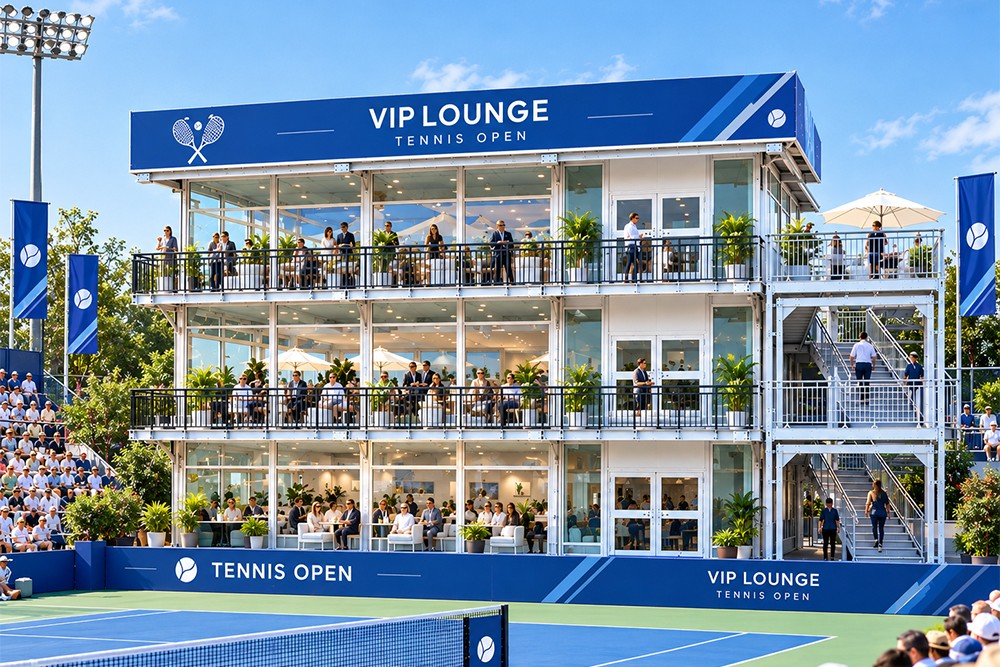
Premium sporting events are becoming more complex, more commercial, and more experience-driven. A modern tournament or international competition is no longer organized around the competition venue alone. Around the field, track, course, or court, organizers shall create hospitality environments, corporate spaces, sponsor activations, premium viewing areas, catering facilities, operational zones, and guest services, often within a limited site and a tightly controlled event schedule.
This is changing the way temporary event infrastructure is designed. For many years, increasing capacity primarily meant expanding horizontally: adding more structures, occupying more ground, and distributing different functions across a larger footprint. As premium event requirements continue to grow while high-value venue space remains limited, this model is becoming less efficient.
KENTEN Triple-Deck Structure represents a different approach. By introducing multi-level spatial planning, it allows premium sporting events to expand not only across the site, but also vertically. Viewing, hospitality, business, brand experience, and operational functions can be organized within one integrated infrastructure system, creating more usable commercial space without requiring the same proportional increase in ground footprint.
The movement toward multi-level event infrastructure is therefore not simply an architectural trend. It reflects a broader change in how premium sporting events use space, generate commercial value, and deliver experiences.
Why Horizontal Expansion Is Becoming Less Efficient
The straightforward way to create more event space is to build outward. Add another tent, extend the footprint, install another hospitality unit, or allocate additional land for sponsor and guest facilities.
For smaller events, this approach can work well. For premium international sporting events, however, available space is rarely unlimited.
Major sporting venues often have fixed boundaries, established circulation routes, existing permanent buildings, spectator zones, technical areas, media facilities, parking requirements, and safety access routes. Golf courses, racing circuits, stadium districts, waterfront venues, and urban event locations can face particularly strong spatial constraints.
At the same time, the commercial value of the available land is not uniform. Locations with the best visibility, proximity to the competition, direct access, or premium viewing opportunities are often the valuable areas of the venue.
Using more ground space therefore does not necessarily create the efficient solution.
This is where vertical infrastructure becomes strategically relevant.
The Shift From Horizontal Space to Vertical Space
Multi-level event infrastructure introduces another dimension into event planning.
Instead of placing every function side by side, different functions can be organized vertically according to their relationship with the event, their operational requirements, and their commercial value.
KENTEN Triple-Deck Structure can establish a clear spatial hierarchy.
The ground level can support arrival, reception, catering, retail, storage, staff operations, and other service functions. The second level can accommodate corporate hospitality, dining, networking, private meetings, and sponsor environments. The upper level can focus on premium viewing, executive hospitality, private lounges, or other high-value guest experiences.
The important point is not that every event shall use exactly the same configuration.
The value lies in having the structural capacity to organize multiple functions vertically.
This allows the event footprint to become more productive.
Instead of viewing vertical space simply as additional floor area, organizers can use each level for a different role within the overall event ecosystem.
Multi-Level Infrastructure Is About More Than Capacity
It would be easy to describe multi-level structures simply as a way to increase floor area. That explanation, however, misses a significant part of their value.
The real advantage is functional separation within an integrated environment.
Consider a premium sporting event where guest reception, catering, corporate meetings, hospitality, viewing, and event operations all need to happen within the same area.
If these functions are distributed horizontally, guests, staff, catering teams, service personnel, and operational traffic may share a larger ground-level environment.
KENTEN Triple-Deck Structure can establish clearer relationships between these activities.
Operational functions can remain concentrated where service access is efficient. Hospitality can occupy a more private level. Premium viewing can move higher, creating elevated sightlines and a different guest experience.
The result is not simply more space.
It is better-organized space.
For premium events, that distinction matters because commercial performance increasingly depends on how efficiently the physical environment supports different categories of users.
From Spectator Infrastructure to Experience Infrastructure
The traditional sports venue is primarily organized around spectators.
Premium sporting events are organized around a much broader group of participants.
There are spectators, VIP guests, corporate clients, sponsors, partners, media representatives, event staff, catering teams, brand teams, and operational personnel. Each group has different requirements, and those requirements increasingly overlap within the same event environment.
A premium hospitality guest may watch the competition, dine with clients, attend a business meeting, interact with a sponsor, and participate in an evening reception without leaving the structure.
This changes the purpose of the infrastructure.
The structure is no longer simply providing a place to watch.
It is providing a place to experience, interact, entertain, communicate, and conduct business around the event.
KENTEN Triple-Deck Structure is designed around this broader understanding of event infrastructure. Its multi-level configuration creates the physical framework for these different experiences to coexist while remaining connected.
The Commercial Value of Elevated Viewing
Viewing remains one of the valuable functions of premium sporting infrastructure.
An elevated position can provide a different relationship with the competition, particularly in environments where sightlines from ground level are restricted by spectators, equipment, barriers, or other event facilities.
But premium viewing can also be commercially integrated with hospitality.
Instead of treating viewing as a standalone grandstand function, an upper level can connect the viewing experience directly to private lounges, dining areas, executive spaces, and sponsor environments.
KENTEN Triple-Deck Structure creates a more complete premium experience.
A guest does not have to choose between hospitality and viewing. The infrastructure can provide both within the same environment.
For organizers and commercial partners, this can make premium space more valuable because the physical environment supports both the experience of the event and the business objectives surrounding it.
Hospitality Is Moving Upward
The evolution of premium sports hospitality is closely connected to the movement toward multi-level infrastructure.
Traditional hospitality facilities are often single-level environments with limited opportunities for spatial differentiation. As expectations increase, premium guests increasingly require different levels of privacy, access, comfort, and viewing.
KENTEN Triple-Deck Structure can establish these distinctions vertically.
The lower level can remain active and accessible, supporting reception, catering, retail, and guest circulation. The middle level can become the primary corporate hospitality environment, with lounges, dining, networking, and meeting spaces. The upper level can provide the exclusive viewing and executive experience.
This creates a natural hierarchy without requiring every function to occupy a separate building.
For event organizers, that can simplify the relationship between capacity, hospitality programming, and site utilization.
Turning Event Space Into Business Space
One of the significant changes in premium sporting events is the growing relationship between sports and business.
International tournaments and major sporting events provide companies with opportunities to entertain clients, meet partners, engage stakeholders, strengthen relationships, and create commercial visibility.
A hospitality environment therefore has to perform as more than a lounge.
It needs to function as a business environment.
KENTEN Triple-Deck Structure can support this through dedicated meeting spaces, corporate lounges, private dining, networking environments, sponsor areas, and executive hospitality.
The event becomes the reason people gather, but the infrastructure creates the environment in which business relationships can develop.
This is an important reason why multi-level planning is becoming more relevant. Vertical organization allows different degrees of public access, privacy, and commercial activity to exist within one integrated structure.
Creating More Opportunities for Brand Experience
The same principle applies to sponsors and commercial partners.
A premium sporting event can provide enormous exposure, but the value of sponsorship increasingly depends on the quality of the physical experience surrounding the brand.
KENTEN Triple-Deck Structure creates multiple opportunities for brand integration.
The exterior can establish the visual identity of a sponsor or event. Ground-level areas can support product demonstrations, retail, reception, and public-facing activation. Hospitality levels can become branded lounges or corporate environments. Premium viewing areas can incorporate private sponsor experiences.
Lighting, audiovisual systems, architectural finishes, graphics, digital displays, and interior design can reinforce the brand throughout the structure.
This creates a shift from brand visibility to brand environment.
The sponsor is no longer simply visible within the event.
The sponsor can become part of the environment in which guests experience the event.
One Structure, Multiple Operational Layers
The movement toward multi-level infrastructure also reflects a growing need for operational integration.
A premium sporting event may require:
Guest reception and registration
Catering and food service
Storage and logistics
Staff facilities
Corporate hospitality
Private meetings
Premium viewing
Brand activation
Audiovisual systems
Lighting
Climate control
Electrical distribution
Back-of-house access
These functions do not operate independently.
They form an interconnected system.
KENTEN Triple-Deck Structure provides the structural framework within which these systems can be coordinated. Structure, envelope, elevated flooring, interior partitions, lighting, electrical systems, HVAC, audiovisual equipment, branding, and operational planning can be developed as components of one event environment.
This is what differentiates a multi-level infrastructure approach from simply stacking temporary floors.
The objective is not to create more levels for their own sake.
It is to create a more capable event environment.
Fast Deployment for Fixed Event Calendars
Premium sporting events operate according to fixed calendars. A race weekend, tournament, championship, or international competition cannot simply be postponed because construction is taking longer than expected.
This creates a fundamental requirement for temporary infrastructure: it shall combine architectural ambition with deployment efficiency.
A modular structural system can provide a practical alternative to permanent construction when an event requires substantial space for a limited operational period.
KENTEN Triple-Deck Structure is based on modular construction principles, allowing the infrastructure to be planned, manufactured, assembled, dismantled, transported, and reconfigured according to project requirements.
This creates an important balance between permanence of experience and temporariness of deployment.
The building may just operate for an event cycle, but the environment can still be designed around premium architectural, hospitality, and operational expectations.
Modular Infrastructure Can Scale With the Event
Not every premium sporting event requires the same amount of hospitality or commercial space.
One event may require a compact executive environment. Another may require a large hospitality program with multiple sponsor zones, dining areas, meeting spaces, and premium viewing levels.
A modular approach allows the infrastructure to respond to these differences.
Additional modules can expand the footprint horizontally, while the multi-level configuration expands usable area vertically.
This creates two dimensions of scalability:
Horizontal scalability allows the structure to become longer or larger according to capacity and functional requirements.
Vertical scalability allows the available footprint to accommodate more functions through multi-level planning.
Together, these capabilities create a more adaptable event infrastructure model.
KENTEN Triple-Deck Structure can therefore grow with the commercial requirements of the event rather than requiring a completely different architectural solution each time.
Relocatability Changes the Value of Temporary Infrastructure
A major sporting event may only occupy a venue for a few days or weeks, but the infrastructure supporting it can have a much longer useful life.
A modular KENTEN Triple-Deck Structure can be designed for repeated deployment, allowing the same infrastructure asset to support different event locations and configurations.
This changes the economic logic of temporary architecture.
For organizers and event infrastructure operators managing recurring event calendars, this can create greater flexibility and a stronger long-term return from the structural system.
The infrastructure effectively travels with the event program.
Premium Does Not Have to Mean Permanent
For many years, temporary architecture was associated with basic functionality. If a facility was only required for a short period, there was often an assumption that the environment could be less sophisticated than a permanent building.
Premium sporting events are changing this expectation.
Guests now expect comfortable environments. Sponsors expect professional brand presentation. Corporate clients expect spaces suitable for meetings and hospitality. Organizers expect infrastructure that can operate reliably within demanding schedules.
The temporary nature of the structure does not reduce these expectations.
KENTEN Triple-Deck Structure addresses this through an integrated approach to architecture and engineering. The structure can incorporate premium envelopes, elevated flooring, interior fit-out, glazing, lighting, HVAC, audiovisual systems, branding, and other project-specific components.
The result is a temporary infrastructure system designed to deliver a permanent-quality commercial experience where required.
KENTEN Triple-Deck Structure: A New Direction for Premium Event Infrastructure
The movement toward multi-level event infrastructure is ultimately a response to several changes happening at the same time.
Premium sporting events are becoming more commercial.
Available event space is becoming more valuable.
Guest expectations are becoming more sophisticated.
Sponsors require stronger physical experiences.
Corporate hospitality is becoming more business-oriented.
Event calendars demand faster deployment.
And temporary infrastructure increasingly needs to operate as a reusable asset rather than a one-time facility.
KENTEN Triple-Deck Structure brings these requirements together through a vertically organized modular environment.
Rather than simply adding another floor, it creates a framework in which viewing, hospitality, business, brand experience, and operations can be coordinated within one structure.
That makes the concept particularly relevant to high-end sporting events where the physical environment is becoming an increasingly important part of commercial performance.
Multi-Level Infrastructure as the Next Step in Event Architecture
The future of premium sporting events will not necessarily be defined by larger footprints.
In many locations, the more important question will be how intelligently the available footprint is used.
Multi-level infrastructure provides one answer.
By building vertically, event organizers can create additional hospitality capacity, premium viewing opportunities, business environments, and operational functions without relying entirely on horizontal expansion.
But the real opportunity goes beyond space efficiency.
It is about creating an event environment in which different forms of value can exist together.
Guests can watch.
Companies can meet.
Sponsors can activate.
Brands can communicate.
Operators can work.
And the event itself can become the center of a temporary commercial environment.
KENTEN Triple-Deck Structure provides the structural and spatial framework for this transition.
Fast in deployment.
Modular in configuration.
Scalable in capacity.
Relocatable across event programs.
Premium in experience.
As premium sporting events continue to evolve, multi-level infrastructure offers a way to make limited space perform at a much higher level—not simply by adding more floors, but by turning vertical space into a strategic part of the event’s commercial, hospitality, and operational infrastructure.
FAQ
Why are premium sporting events moving toward multi-level infrastructure?
Premium sporting events increasingly need to accommodate hospitality, corporate business, sponsor activation, premium viewing, and operational functions within limited sites. Multi-level infrastructure allows these functions to be organized vertically, increasing usable space without requiring the same proportional expansion of the ground footprint.
What functions can be incorporated into KENTEN Triple-Deck Structure?
Depending on the project, KENTEN Triple-Deck Structure can accommodate reception, catering, retail, storage, corporate hospitality, private lounges, dining, business meetings, networking, sponsor activation, premium viewing, staff functions, and other event-specific requirements.
Is KENTEN Triple-Deck Structurealsosuitable for motorsport?
Yes. KENTEN Triple-Deck Structure can be adapted for a broad range of premium sporting events, including golf tournaments, tennis competitions, football events, basketball tournaments, horse racing, motorsport, and other high-value commercial sporting programs.
How does vertical infrastructure improve site utilization?
Instead of placing every function across a larger ground footprint, KENTEN Triple-Deck Structure allows different functions to occupy different levels within the same structural footprint. This can be particularly valuable at venues where land is limited or commercially important.
Can KENTEN Triple-Deck Structure be customized?
Yes. Modular planning allows KENTEN Triple-Deck Structure to be configured according to site conditions, event capacity, viewing requirements, hospitality programs, branding requirements, interior functions, and operational needs.
How does KENTEN Triple-Deck Structure differ from a conventional hospitality tent?
A conventional hospitality tent generally provides a single-level enclosed environment. KENTEN Triple-Deck Structure introduces vertical spatial organization, allowing hospitality, premium viewing, business functions, branding, and operations to be integrated across multiple levels.
Why is KENTEN Triple-Deck Structure commercially valuable?
KENTEN Triple-Deck Structure allows a limited event footprint to support more functions and create different levels of guest experience. This can increase opportunities for premium hospitality, corporate engagement, sponsor activation, and high-value viewing while maintaining a more compact site organization.
Conclusion
Premium sporting events are becoming more than competitions. They are increasingly sophisticated environments where entertainment, hospitality, business, branding, and operations converge.
That transformation is creating a new requirement for event infrastructure.
The question is no longer simply how to cover more ground.
It is how to make the available space perform more effectively.
KENTEN Triple-Deck Structure addresses this requirement by introducing a vertical infrastructure strategy that combines multi-level space planning with modular engineering, premium hospitality, elevated viewing, business functions, brand integration, and operational capability.


 HIGH-END SERIES
 STRUCTURE TENTS
 ACCESSORIES