Home » The Structural Logic Behind an Outdoor Pagoda Tent (And Why It Matters for Events)
The Structural Logic Behind an Outdoor Pagoda Tent (And Why It Matters for Events)
July 16, 2026
When event planners search for an outdoor pagoda tent, they’re usually solving a specific problem: they need a structure that looks intentional, holds up in unpredictable weather, and doesn’t require a construction crew to assemble. The pagoda tent sits at an interesting intersection — it’s neither a basic pop-up canopy nor a full permanent structure, and that middle ground is exactly where its engineering decisions become worth examining.
Why the Pointed Roof Isn’t Just Aesthetic
The pyramid peak is the most recognizable feature of a pagoda-style tent, but its function goes beyond visual identity. A steeply angled roof sheds rainwater faster than a flat or low-pitch canopy, reducing pooling load on the fabric. It also creates a natural upward airflow channel that can reduce standing pressure on the surface when wind moves across the roof — a meaningful difference when gusts arrive at an angle.
This geometry is one reason pagoda tents are widely used outdoors instead of flat-roof canopies of similar footprint. The shape helps water run off efficiently rather than letting it linger.
Frame Material and Why 6061-T6 Aluminum Gets Specified
Not all aluminum is the same. The 6061-T6 alloy used in pagoda tent frames is a heat-treated structural grade with much higher strength than softer, non-heat-treated aluminum commonly used in light-duty products. It resists corrosion well, which matters for structures that spend months outdoors across multiple seasons.
The “T6” designation refers to the tempering process — solution heat-treated and artificially aged — which gives the alloy its mechanical properties. For a tent frame that gets assembled, disassembled, and reassembled repeatedly, that stability is more relevant than raw strength alone.
Hot-dip galvanized steel inserts at the connection points add a second layer of logic: steel handles concentrated loads and joint wear well, so the hybrid approach puts each material where it is commonly used to perform best.
What “Clear-Span” Actually Means in Practice
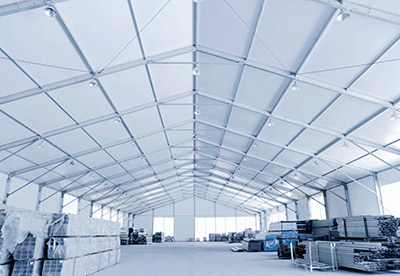
A clear-span interior means no internal support columns. Every square meter of floor space is usable. For a brand activation or exhibition booth, this isn’t a luxury — it’s a layout requirement. Internal poles force exhibitors to design around obstacles, which limits furniture placement, sightlines, and foot traffic flow.
The structural trade-off is that load must transfer through the perimeter frame and roof geometry rather than through interior posts. This is why the frame section and connection design matter more in a clear-span tent than in a simpler supported canopy.
Fabric Specification: Reading Past the Marketing
The PVC-coated polyester fabric used on pagoda tents carries several certifications worth understanding:
Standard
What It Covers
DIN 4102 B1
Flame-retardant classification used in Germany
M2 (French standard)
Flame-retardant classification used in France
BS 5438 / 7837
UK fire testing standards for textile materials
NFPA 701
US standard for flame-resistant textiles
The roof cover weight of 800–950 g/sqm (opaque) is relatively heavy for event tent fabric. Heavier fabric often supports better weathering performance and longer service life, but it also adds handling weight during installation. The 650 g/sqm translucent sidewall option trades some opacity for diffused natural light — useful for daytime events where interior brightness matters.
A temperature operating range of -30°C to +70°C covers most outdoor event conditions globally, including cold-climate winter markets and very hot summer installations.
Where Pagoda Tents Actually Get Deployed
The modular nature of pagoda tent structures makes them practical across a wider range of scenarios than their appearance suggests:
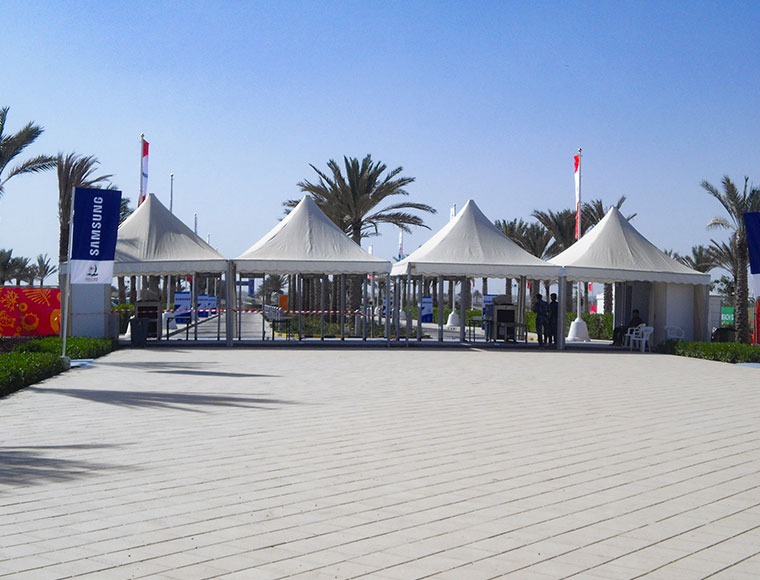
Brand activations and product showcases — the peaked silhouette reads as intentional and premium from a distance, which matters for visual brand presence in open spaces
Exhibition corridors — multiple units can be aligned to create covered walkways or segmented booth rows
Temporary service stations — medical posts, information points, and registration areas benefit from the quick-deploy, weather-resistant enclosure
Beach and coastal events — the corrosion-resistant frame is useful in salt-air environments
FAQ
Q: Can pagoda tents be connected side by side? Yes. Most modular pagoda tent systems are designed with standardized footprints that allow units to share a gutter channel between peaks, creating a continuous covered area. The structural integrity of each unit remains independent, which simplifies layout planning and covered circulation.
Q: Is 80–100 km/h wind resistance enough for outdoor events? For many planned outdoor events, it can be workable. That said, wind resistance figures for tents are usually conditional rather than absolute. Real-world performance depends on anchoring method, site exposure, soil or ballast conditions, and whether the tent is fully enclosed or open-sided. Proper ground anchoring — whether staking, ballast weights, or frame anchoring — is as important as the frame rating itself.
Q: How long does assembly take? A standard pagoda tent unit can usually be installed faster than heavier temporary structures, especially when the crew is familiar with the system and the site is straightforward. The modular aluminum frame uses a limited number of component types, which reduces the learning curve for crews assembling the structure for the first time.
For us, the pagoda tent represents a category where structural engineering and event logistics overlap. The decisions made at the frame joint, the fabric weight, and the roof pitch all have downstream effects on how the structure performs — and how the event inside it runs. An outdoor pagoda tent that keeps a clear interior, sheds rain efficiently, and supports repeated setup cycles isn’t the result of aesthetic choices alone. It’s the result of engineering ones.


 HIGH-END SERIES
 STRUCTURE TENTS
 ACCESSORIES