Home » Double Decker Tents: How to Double Your Commercial Space & ROI
Double Decker Tents: How to Double Your Commercial Space & ROI
June 15, 2026
Introduction: The Next Commercial Advantage Is No Longer More Land—It’s Better Space Utilization
For decades, commercial development followed a simple equation:
More visitors required more floor area. More business activity required larger buildings. More revenue required more land.
This model shaped exhibition centers, hospitality venues, retail developments, sports facilities, resort destinations, and corporate campuses around the world.
Today, however, the economics of commercial development are changing.
Land costs continue to rise. Prime locations are becoming increasingly constrained. Development approvals are taking longer. Permanent construction costs remain volatile. At the same time, brands, developers, event organizers, and investors are under pressure to maximize returns from every square meter of usable space.
As a result, the most successful projects are no longer measured solely by footprint.
They are measured by how efficiently they transform space into revenue, engagement, hospitality, and commercial value.
This shift is driving a new focus across the industry:
Vertical space is becoming one of the most valuable assets in modern commercial development.
Rather than expanding outward, leading organizations are increasingly expanding upward—creating multi-level environments that generate more business activity, deliver premium experiences, and maximize the value of strategic locations.
This is where modular double-deck infrastructure is creating new opportunities.
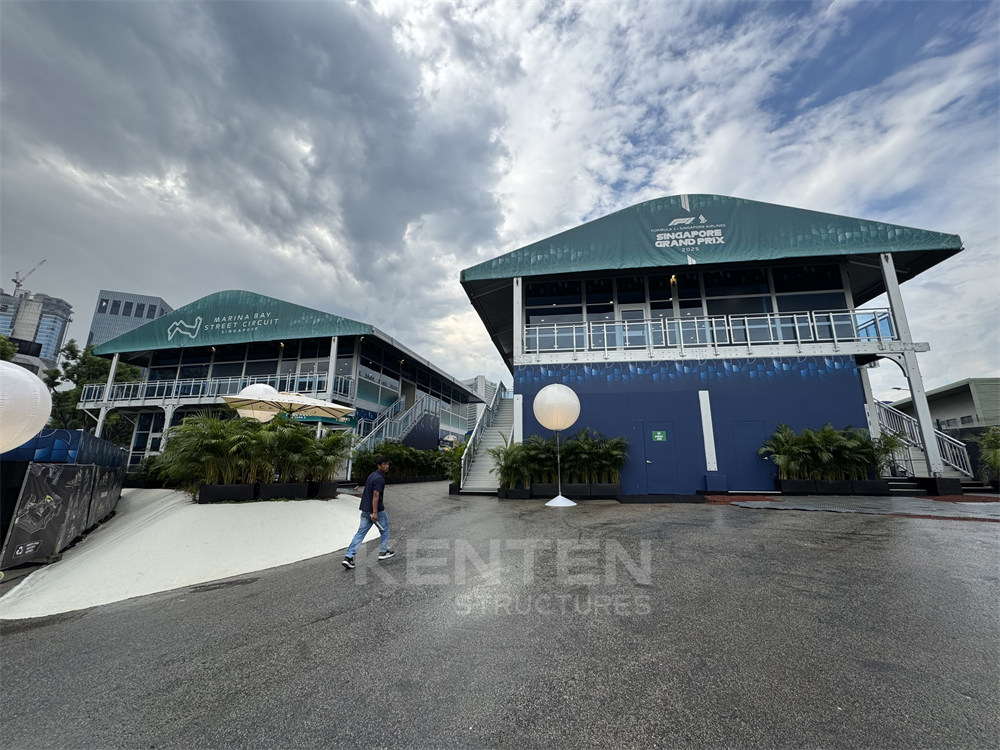
Modern systems such as KENTEN Double-Decker Structure allow developers, event organizers, hospitality operators, and brands to unlock additional commercial capacity without the cost, complexity, and permanence of traditional construction.
Why Horizontal Expansion Is Becoming Increasingly Difficult
Across virtually every commercial sector, organizations face the same challenge.
The demand for usable space is growing faster than the availability of practical development opportunities.
Several market forces are driving this trend:
Rising Land Costs
Premium locations near city centers, waterfronts, transportation hubs, tourism destinations, exhibition venues, and sporting facilities continue to command higher prices.
Acquiring additional land is often the most expensive component of expansion.
Development Restrictions
Permanent construction projects frequently require:
Planning approvals
Environmental reviews
Infrastructure upgrades
Long construction schedules
These factors can delay projects by months or even years.
Short-Term Commercial Opportunities
Many commercial opportunities are temporary by nature:
Major sporting events
Trade exhibitions
Product launches
Seasonal tourism
Development marketing campaigns
Building permanent facilities for temporary demand rarely makes financial sense.
Pressure to Improve ROI
Investors increasingly evaluate projects based on revenue generation rather than building size.
The question is no longer:
“How much space can we build?”
Instead, it becomes:
“How much value can we create from the space we already control?”
This shift is fundamentally changing how commercial infrastructure is planned.
The Rise of Vertical Commercial Infrastructure
Historically, multi-level structures were associated primarily with permanent buildings.
Today, modular engineering is changing that assumption.
Modern double-deck systems provide many of the advantages of conventional multi-story development while offering significantly greater flexibility.
They allow organizations to:
Increase usable floor area
Separate public and VIP functions
Improve operational efficiency
Create premium hospitality environments
Maximize high-value locations
Expand capacity without permanent construction
Most importantly, they transform a limited footprint into a significantly larger commercial asset.
Instead of viewing a site as a single-level space, operators can create multiple layers of commercial activity.
This creates entirely new possibilities for revenue generation.
Commercial Development Is Shifting From Square Meters to Revenue Per Square Meter
One of the most significant changes occurring in commercial real estate and event infrastructure is the growing focus on revenue efficiency.
The most successful developments are no longer necessarily the largest.
They are often the most productive.
A traditional single-level tent may support:
Retail activity
Product displays
Guest circulation
A double-deck commercial environment can support:
Ground Level:
Retail
Exhibitions
Product interaction
Guest services
Upper Level:
VIP hospitality
Private events
Executive meetings
Premium viewing experiences
The same footprint now supports multiple revenue streams simultaneously.
This approach increases both operational efficiency and customer value.
In many cases, vertical infrastructure allows organizations to generate significantly greater returns without increasing land requirements.
How Premium Brands Are Using Vertical Space to Create Stronger Customer Experiences
Global brands increasingly recognize that customer engagement requires more than simple product display.
Consumers, partners, and VIP guests expect immersive experiences.
This is particularly true across industries such as:
Automotive
Luxury goods
Technology
Lifestyle brands
Consumer electronics
A multi-level environment creates natural separation between public engagement and private hospitality.
Ground Floor:
Product demonstrations
Interactive experiences
Brand activations
Upper Floor:
Executive hospitality
VIP lounges
Media events
Investor meetings
This structure creates a more sophisticated customer journey while maximizing site utilization.
Instead of building temporary showrooms and separate hospitality facilities, organizations can integrate multiple business functions into a single commercial platform.
Outdoor Exhibitions Are Redefining Space Utilization
Large-scale outdoor exhibitions face a unique challenge.
Heavy equipment, machinery, vehicles, and industrial products require substantial display areas.
At the same time, exhibitors must accommodate:
Buyers
Distributors
Investors
Government officials
Media representatives
Events such as major construction, mining, agriculture, energy, and infrastructure exhibitions increasingly require environments that combine display, hospitality, and business development.
This is where double-deck infrastructure delivers exceptional value.
Ground Level:
Equipment displays
Product demonstrations
Customer engagement
Upper Level:
Meeting facilities
VIP hospitality
Executive networking spaces
Instead of sacrificing valuable exhibit area for hospitality functions, organizers can use vertical space to accommodate both.
The result is improved visitor experience and higher commercial productivity from the same footprint.
Hospitality Is Moving Upward
The hospitality industry is also embracing vertical development strategies.
Across resorts, waterfront destinations, tourism projects, and mixed-use developments, elevated hospitality environments are becoming increasingly desirable.
Elevation creates value, and upper-level spaces often provide:
Better views
Greater privacy
Premium guest experiences
Enhanced event opportunities
Developers increasingly recognize that a second level is not simply additional floor area.
It is premium floor area.
For destination operators, this creates opportunities to develop:
VIP lounges
Private dining venues
Corporate hospitality areas
Event terraces
Executive gathering spaces
without committing to permanent structures that may limit future flexibility.
Why Golf and Sporting Events Are Creating New Demand for Elevated Infrastructure
Few industries illustrate the value of vertical space more clearly than golf and outdoor sporting events.
Unlike urban developments, these venues often operate on uneven terrain.
Traditional construction can be difficult, expensive, or impractical.
At the same time, sponsors, hospitality providers, and event organizers require premium viewing environments.
This challenge has led to the growing adoption of integrated elevated infrastructure solutions.
The combination of KENTEN Elevated Flooring System + KENTEN Double-Decker Structure creates a complete hospitality platform capable of transforming challenging sites into premium commercial environments.
KENTEN Elevated Flooring System:
Creates a stable level surface
Accommodates uneven terrain
Protects existing turf and landscapes
Supports temporary and semi-permanent installations
KENTEN Double Decker Tent then creates:
Ground Level for reception, catering, and operations
Upper Level for hospitality lounges, sponsor facilities, spectator viewing platforms, and executive networking environments
Rather than adapting the event to the site, the infrastructure adapts to the environment.
This flexibility is becoming increasingly valuable for golf tournaments, motorsport events, equestrian competitions, and other outdoor sporting venues.
Data Centers Are Creating an Unexpected Opportunity for Vertical Commercial Infrastructure
The rapid expansion of artificial intelligence and digital infrastructure is creating a new category of commercial space requirements.
Modern data center developments often need:
Visitor centers
Training facilities
Customer experience environments
Operations support spaces
Executive briefing centers
However, these requirements frequently emerge faster than permanent facilities can be delivered.
Modular double-deck infrastructure provides a practical solution.
Ground Floor:
Operations support
Security functions
Technical services
Upper Floor:
Customer engagement
Executive meetings
Demonstration facilities
As AI infrastructure continues expanding globally, flexible commercial support environments will become increasingly important.
This represents one of the most promising emerging applications for modular commercial infrastructure.
The Future of Commercial Development Is Not Bigger—It’s Smarter
The traditional approach to growth was simple:
Acquire more land.
Build larger facilities.
Increase footprint.
The future looks very different.
Leading developers, event organizers, hospitality operators, and brands are increasingly focused on maximizing the value of existing space.
This means:
Higher utilization
Greater flexibility
Faster deployment
Improved revenue generation
Better customer experiences
Vertical infrastructure aligns perfectly with these priorities.
It enables organizations to expand capacity, improve functionality, and increase commercial output without the limitations associated with permanent expansion.
The most valuable asset is no longer simply land.
It is the ability to unlock more value from every square meter already available.
Conclusion: Turning Vertical Space Into Commercial Advantage
As commercial development continues to evolve, the organizations that succeed will be those that view space differently.
Rather than treating land as a fixed limitation, they will treat it as a platform for innovation.
Vertical infrastructure allows businesses to create premium hospitality environments, enhance customer experiences, expand operational capacity, and generate new revenue opportunities from the same footprint.
For modern commercial development, the question is no longer how much space is available.
The question is how effectively that space can be utilized.
KENTEN Double Decker Tent represents a new generation of modular commercial infrastructure designed to help organizations answer that challenge.
By combining engineering flexibility, rapid deployment, premium functionality, and scalable vertical design, it transforms underutilized space into a powerful commercial asset.
In today’s market, the most valuable square meter may not be the one beside you.

 HIGH-END SERIES
 STRUCTURE TENTS
 ACCESSORIES