Home » A-Structure Tent: A Turnkey BOH Infrastructure Solution for Formula One
A-Structure Tent: A Turnkey BOH Infrastructure Solution for Formula One
August 19, 2026
Formula One is often viewed through its most visible infrastructure: the circuit, pit lane, paddock, grandstands, hospitality facilities and broadcast environments.
But behind every Grand Prix is another infrastructure system that is rarely seen by spectators.
It includes logistics facilities, equipment storage, catering operations, technical workspaces, workforce facilities, temporary offices, service areas, maintenance zones and other back-of-house functions that keep the event operating before, during and after the race.
These spaces are not secondary to the event.
They are part of the operational infrastructure that makes the event possible.
For Formula One, however, BOH infrastructure must work within an unusually demanding environment. Construction schedules are compressed, sites change from one Grand Prix to another, available land may already be occupied by other event functions, and facilities may need to be installed, commissioned, operated and removed within a defined event lifecycle.
This creates a different infrastructure requirement from conventional permanent construction.
BOH is an operational requirement. KENTEN A-Structure Tent provides a turnkey infrastructure solution for that requirement.
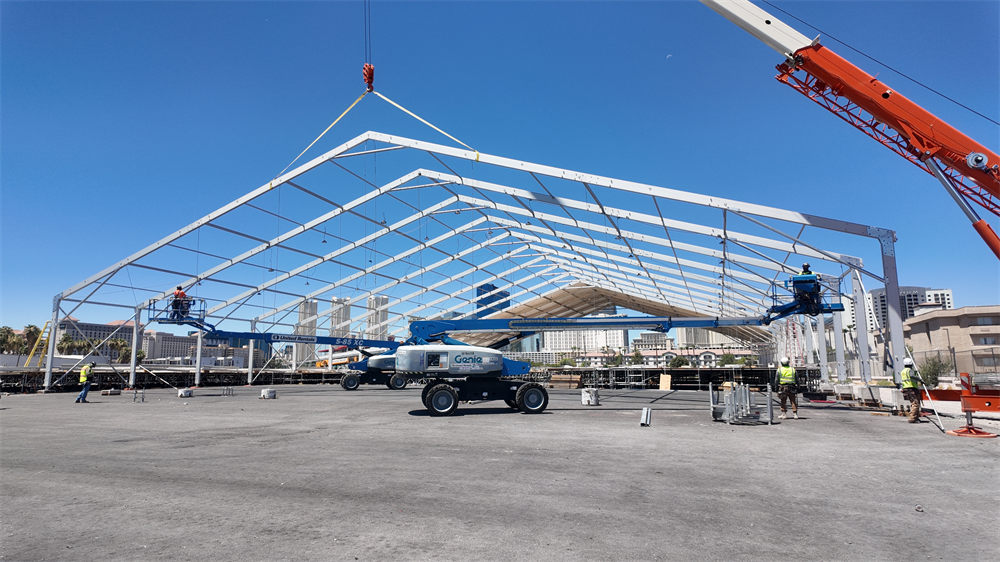
At the Las Vegas Grand Prix, KENTEN A-Structure Tent demonstrates how a modular large-span structure can become part of this operational infrastructure system—from structural assembly on site to a fully configured temporary facility.
The result is more than covered space.
It is a deployable building system engineered around the operational requirements of a Formula One event.
Beyond the RacingCircuit: BOH as Part of the F1 Infrastructure System
A Formula One Grand Prix is effectively a temporary operating environment built around a race circuit.
The track may be the center of the event, but the event itself depends on a much larger network of supporting spaces.
BOH facilities can support multiple functions, including logistics, storage, catering, technical operations, workforce support, equipment handling and temporary administration. These functions can have very different spatial and environmental requirements, yet they often need to operate within the same constrained event site.
This is where infrastructure flexibility becomes important.
A permanent building is generally designed around a fixed location, fixed use and long-term operating model. Formula One infrastructure operates under a different logic.
The facility needs to be available where the event happens, configured around the site, operational during the event window and capable of being dismantled or repurposed afterward.
KENTEN A-Structure Tent is designed around this temporary infrastructure logic.
Its modular aluminum structural system creates large, column-free interior volumes that can be configured for different operational requirements while maintaining the fundamental structural platform.
This allows BOH infrastructure to be treated not as an isolated tent installation, but as a configurable component of the wider Grand Prix infrastructure ecosystem.
From BOH Requirement to Turnkey Infrastructure
The distinction between a conventional temporary tent and a turnkey BOH solution is important.
A conventional tent primarily answers one question:
How do we create covered space quickly?
A BOH infrastructure solution needs to answer a much broader set of questions:
How do we create an operational building, at the right location, with the required capacity, access, environmental conditions, flooring and internal configuration, within the available construction window?
That requires more than a roof and structural frame.
A temporary BOH facility may require:
large-span operational areas for equipment and logistics;
enclosed rooms and partitioned workspaces;
controlled internal environments;
dedicated personnel and service access;
flooring and elevated platforms;
lighting, electrical and HVAC systems;
doors and internal circulation;
storage and equipment-handling areas;
catering or service facilities.
KENTEN A-Structure Tent provides the structural platform around which these requirements can be developed.
The structure establishes the primary building volume. The envelope, flooring, internal partitions and building systems can then be configured according to the intended operational function.
This is what makes the concept closer to temporary modular infrastructure than a conventional event tent.
A Large-Span Building System for Operational Flexibility
BOH facilities frequently require unobstructed floor areas.
Logistics equipment needs to move. Vehicles and machinery may need access. Materials need to be stored and handled efficiently. Workforce circulation must coexist with operational activities.
Internal columns can therefore become a constraint.
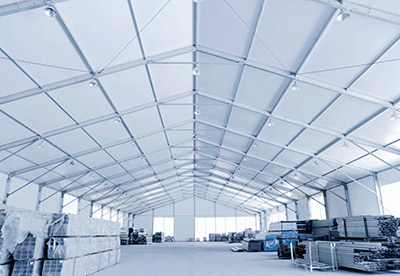
KENTEN A-Structure Tent uses a large-span aluminum structure to create open internal space without relying on a dense grid of interior supports. Depending on the project configuration, KENTEN Modular Structures can achieve large clear spans while maintaining the modularity required for temporary deployment.
This creates flexibility in how the interior is planned.
The same structural volume can support a storage-oriented layout, a technical workspace, a catering operation, a temporary office environment or a combination of functions.
The infrastructure does not need to be redesigned from the ground up every time the operational requirement changes.
Instead, the configuration can evolve around the same underlying structural logic.
That is particularly valuable in Formula One, where infrastructure requirements can vary significantly between venues.
Engineered for Real-World Grand Prix Sites
Every Grand Prix presents a different site.
The available terrain, existing pavement, access routes, underground conditions, event footprint and adjacent infrastructure can all influence how temporary buildings are deployed.
A modular infrastructure system therefore needs to be adaptable to the physical environment rather than assuming that every site behaves like a conventional building plot.
The Las Vegas installation provides a clear example.
KENTEN A-Structure Tent is assembled directly on the event site, with the structural frame progressively lifted and installed using cranes and aerial work platforms.
The installation process illustrates one of the fundamental advantages of modular temporary construction: the building does not have to exist before arriving at the event.
Its components can be transported to the venue and assembled into the required building volume on site.
This allows the construction sequence to become part of the infrastructure strategy.
Instead of waiting for a permanent building to be constructed, the event operator can establish the required operational facility within the temporary event environment.
Engineering the Structure Around Site-Specific Loads
Temporary does not mean structurally simple.
For an international sporting event, a temporary building still needs to be engineered for the environmental conditions and operational requirements of its specific location.
KENTEN A-Structure Tent can be engineered around applicable project requirements using recognized structural standards and site-specific design criteria, including ASCE/SEI 7-22, the 2024 International Building Code (IBC), and EN 13782, where applicable to the project and jurisdiction.
For a Formula One project, these standards form part of a broader engineering process in which the structure, site, anchoring, environmental loads, occupancy, installation methodology and local approval requirements are considered together.
The final engineering design therefore remains project-specific.
KENTEN A-Structure Tent as a Modular Building Platform
One of the characteristics of KENTEN A-Structure Tent is the separation between the structural platform and the final operational configuration.
The aluminum frame provides the primary structural system.
The envelope system can then be selected according to the environmental and architectural requirements. Depending on the project, wall and roof configurations can incorporate different materials and systems, including PVC fabric, insulated panels, aluminum panels, glass and other facade solutions.
This allows the same structural concept to support very different operating environments.
A logistics facility may prioritize accessibility and large open floor areas.
A catering facility may require a more controlled internal environment.
A technical workspace may require enhanced enclosure and service integration.
A temporary office may prioritize internal subdivision, thermal comfort and personnel circulation.
The structure remains the infrastructure platform.
The building configuration responds to the function.
This distinction is central to the concept of turnkey temporary infrastructure.
Why Modularity Matters for Formula One
Formula One operates across a global calendar.
The infrastructure strategy therefore cannot depend entirely on permanent facilities at one location.
Every new venue introduces a different combination of physical conditions, operational requirements and construction constraints.
The infrastructure has to move with the event.
This creates a fundamental difference between permanent construction and modular temporary infrastructure.
Aspect
Permanent Building
KENTEN A-Structure Tent
Location
Designed primarily for a fixed location
Designed for repeated temporary deployment
Construction Cycle
Long construction cycle
Rapid modular assembly
Configuration
Fixed building configuration
Configurable building platform
Site Relationship
Permanent relationship with the site
Adaptable site and anchoring strategy
Deployment
Conventional ground-level construction
Ground-level or elevated deployment
Relocatability
Difficult to relocate
Designed for dismantling and redeployment
Operational Model
Optimized for long-term fixed use
Optimized for operational flexibility
The objective is not necessarily to replace permanent buildings.
It is to provide an infrastructure model for functions where permanent construction may not be the most efficient response to a temporary or variable requirement.
From Installation to Operational Continuity
The value of temporary infrastructure should not be measured only by how quickly the structure can be erected.
For Formula One, the more important question is whether the facility can support operations reliably throughout its required lifecycle.
That lifecycle begins before installation.
Components need to be transported, site conditions need to be reviewed, the installation sequence needs to be coordinated, and structural and anchoring requirements need to be established.
It continues through assembly, commissioning and event operation.
And it concludes with dismantling, transportation, storage, reconfiguration or redeployment.
KENTEN A-Structure Tent is designed around this complete lifecycle rather than treating installation as the final objective.
This is where modularity creates value.
A structure that can be dismantled and redeployed can potentially support multiple events rather than becoming a single-use construction asset.
For a global event environment, that changes the economic logic of temporary infrastructure.
The Las Vegas Example: Temporary Infrastructure at Grand Prix Scale
The Las Vegas Grand Prix provides an especially relevant environment for examining this infrastructure model.
The event operates within a highly urbanized environment where temporary event infrastructure must coexist with existing roads, buildings, utilities, hospitality facilities, transportation systems and other operational requirements.
The Las Vegas installation of KENTEN A-Structure Tent demonstrates how a large-span temporary structure can be constructed directly within this complex event environment.
The construction images show the structural frame progressing from individual components to a substantial building volume, with cranes and aerial work platforms supporting the installation process.
This is the physical expression of modular infrastructure.
The building is not delivered as a finished object.
It is assembled from an engineered system.
Once completed, that system can become a functional BOH facility supporting the operational requirements behind the race.
And when the event infrastructure is no longer required, the same modular logic allows the structure to enter the next stage of its lifecycle.
Building the Infrastructure Behind the Race
The visible parts of Formula One receive public attention.
The race track.
The podium.
The grandstands.
The paddock.
The hospitality environments.
But none of these functions operate independently.
Behind them is a network of logistics, people, equipment, materials, services and temporary facilities.
BOH infrastructure provides the physical space in which many of these activities take place.
That makes it part of the operational backbone of the Grand Prix.
KENTEN A-Structure Tent approaches this requirement from an infrastructure perspective.
It combines a modular large-span structural system with configurable envelope solutions, optional elevated flooring and project-specific engineering to create temporary operational buildings that can adapt to changing sites and functions.
The Las Vegas installation demonstrates that the concept extends beyond simply providing shelter.
KENTEN A-Structure Tent turns BOH from a space requirement into a deployable infrastructure system—engineered for large spans, adaptable site conditions, elevated applications and the demanding operational environment of Formula One.
FAQ
What is KENTEN A-Structure Tent used for in Formula One?
KENTEN A-Structure Tent can support a range of back-of-house functions, including logistics, storage, catering, technical operations, workforce support, temporary offices, equipment handling and other operational facilities required around a Grand Prix.
Can KENTEN A-Structure Tent be installed on different types of terrain?
Yes. KENTEN A-Structure Tent can be engineered for different site conditions and support configurations, subject to project-specific site investigation, foundation or anchoring design and local requirements. It can also be seamlessly integrated with the industry’s popular elevated flooring system.
Can KENTEN A-Structure Tent be used as a fully enclosed BOH facility?
Yes. The structural frame can be combined with different roof, wall, flooring and internal systems to create an enclosed temporary building configured around the required operational function.
Does KENTEN A-Structure Tent comply with ASCE 7-22, IBC 2024 and EN 13782?
Yes. KENTEN A-Structure Tent is engineered to meet applicable requirements based on standards such as ASCE/SEI 7-22, the 2024 IBC and EN 13782, subject to the specific project, site conditions, design loads, anchoring system and jurisdictional approval requirements. Compliance should therefore be verified as part of the project-specific engineering and permitting process.
Can KENTEN A-Structure Tent be reused after a Formula One event?
Yes. Reusability is one of the fundamental principles of KENTEN A-Structure Tent. After dismantling, structural components can be transported, stored, reconfigured and redeployed for other events or applications, subject to inspection and project requirements.
Why use KENTEN A-Structure Tent instead of constructing a permanent BOH building?
For short-duration or recurring events, a permanent building may not align with the required location, construction timeline or long-term utilization. KENTEN A-Structure Tent can provide operational capacity without permanently committing the site to a single building configuration.
Conclusion: Temporary Infrastructure Designed for the Way F1 Operates
Formula One does not operate like a conventional permanent facility.
Its infrastructure moves.
Its requirements change.
Its venues vary.
And its construction windows are compressed.
That is why the most effective temporary infrastructure must do more than assemble quickly.
It needs to be engineered, configurable, deployable, adaptable and reusable.
KENTEN A-Structure Tent provides this capability through a modular large-span structural platform that can be configured for different BOH functions, adapted to site conditions, integrated with elevated flooring and engineered according to applicable international and local requirements.
The Las Vegas Grand Prix installation is a practical example of this approach.
The race happens on the track. But the event operates through the infrastructure behind it.
KENTEN A-Structure Tent is engineered to build that operational backbone.


 HIGH-END SERIES
 STRUCTURE TENTS
 ACCESSORIES