Home » How KENTEN Modular Structure Creates Long-Term Value Beyond Traditional Construction Models
How KENTEN Modular Structure Creates Long-Term Value Beyond Traditional Construction Models
August 4, 2026
Why the Future of Infrastructure Is Moving From Fixed Buildings Toward Adaptive Assets
For generations, construction value has been measured through a traditional framework. A successful project was often defined by three factors: construction efficiency, building durability, and structure performance.
This approach was based on a simple assumption: infrastructure is created for a specific location, a specific function, and a long operational period.
However, modern industries are operating in a very different environment.
Business models change faster. Market demands fluctuate. Events become more dynamic. Organizations require facilities that can respond quickly to new opportunities and challenges.
Under these conditions, traditional construction models face increasing limitations.
A building designed for one permanent purpose may become inefficient when requirements change. Expanding capacity may require major renovation. Relocating operations may require completely new construction. Changing customer expectations may exceed the capability of existing spaces.
This has created a new infrastructure demand: infrastructure shall not only exist. It shall evolve.
KENTEN Modular Structure represents this transformation. Instead of viewing structures as fixed assets connected permanently to one location, modular infrastructure introduces a more flexible approach — one where buildings and spaces can be designed for adaptation, expansion, reuse, and long-term value creation.
The Limitations of Traditional Construction Models in a Changing World
Traditional construction remains an essential part of modern development. Permanent buildings provide stability, durability, and long-term functionality for many applications.
However, their value model is often based on permanence. Once constructed, future changes typically require complex renovation processes, additional construction investment, operational disruption, and longer project timelines.
This creates challenges for industries where flexibility is becoming increasingly important.
An international exhibition may require a distinctive cultural venue for a limited operational period. A sports event may need additional hospitality capacity during major competitions. A hospitality operator may need premium spaces that can adapt to different locations and seasonal demands. An event company may need customized environments that change according to different brands and experiences.
In these situations, the challenge is not simply building a structure. The challenge is creating infrastructure that maintains value when circumstances change. Traditional construction models are often optimized for stability.
Modern industries increasingly require adaptability. This difference has accelerated the development of KENTEN Modular Structure.
What Makes KENTEN Modular Structure Different?
KENTEN Modular Structure changes the relationship between construction and long-term value. Instead of designing a structure only for one final condition, modular systems are developed around flexibility from the beginning.
1. Modular Infrastructure Creates Value Through Adaptability
One of the extraordinary advantages of KENTEN Modular Structure is the ability to respond to changing requirements.
Traditional buildings are usually modified through reconstruction.
Modular structures are designed for transformation. Through engineered modular components, structures can be:
Expanded when additional capacity is required
Reconfigured for different functions
Adapted to new operational needs
Integrated with different envelope and interior solutions
This adaptability allows organizations to reduce the risk of infrastructure becoming outdated.
Instead of replacing assets when requirements change, modular infrastructure allows assets to evolve.
A traditional construction project is often associated with one location and one purpose.
However, KENTEN Modular Structure value increasingly depends on utilization efficiency.
A structure that can support multiple applications creates greater long-term return.
A cultural pavilion designed for one exhibition can later become another public experience space.
A hospitality structure created for one major sporting event can support future premium events.
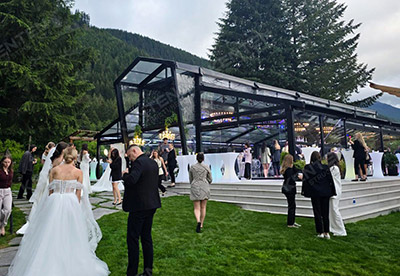
A celebration venue designed for luxury weddings can also become a platform for corporate events and brand activations.
The longer and more effectively infrastructure can be utilized, the greater its lifecycle value becomes.
3. KENTEN Modular Structure Supports Faster Business Evolution
Speed has become a critical factor in modern infrastructure decisions. Organizations increasingly need facilities that can become operational quickly.
Compared with traditional construction approaches, KENTEN Modular Structure benefits from:
Factory-controlled manufacturing
Pre-engineered components
Efficient installation processes
Reduced onsite complexity
This allows businesses and organizations to respond faster to opportunities.
Whether supporting a global event, expanding operational capacity, or creating a temporary commercial environment, speed directly contributes to business value.
Infrastructure is no longer only a physical structure.
It is a strategic capability.
How KENTEN Modular Structures Create Long-Term Value
Modular engineering principle across different infrastructure categories helps organizations create flexible spaces with long-term operational potential.
KENTEN Pyramid Structure: Long-Term Value for Cultural and Expo Infrastructure
Cultural and exhibition projects increasingly require architecture that communicates identity.
Modern visitors expect more than functional spaces.
They expect memorable experiences.
KENTEN Pyramid Structure is commonly seen as cultural or expo infrastructure, providing organizations with a distinctive architectural solution that combines visual impact with modular flexibility.
Its long-term value comes from the ability to support different cultural programs, exhibitions, and public experiences.
Unlike traditional exhibition buildings created for a fixed purpose, KENTEN Pyramid Structure can become an adaptable platform for future cultural activities.
International exhibitions
Cultural pavilions
Brand showcases
Public experience spaces
For cultural organizations and event developers, infrastructure becomes more valuable when it can continue representing creativity, identity, and public engagement beyond one project cycle.
KENTEN Multi-Deck Structure: Maximizing Value Through Hospitality Infrastructure
Large-scale events increasingly depend on premium hospitality environments.
VIP areas, sponsor spaces, corporate lounges, and guest experiences have become essential parts of international sporting and commercial events.
KENTEN Double-Deck Structure or KENTEN Triple-Deck Structure provides a flexible solution for Sports and Hospitality Infrastructure, allowing organizations to maximize available space while creating high-quality environments.
Vertical space optimization
Premium hospitality experiences
Flexible event configurations
Efficient use of limited footprint
For major competitions and international events, hospitality infrastructure directly influences visitor experience and brand value.
KENTEN Multi-Deck Structure provides organizations with the ability to create premium environments without depending entirely on permanent construction.
Luxury weddings, corporate celebrations, and brand events require spaces that reflect identity, atmosphere, and emotional connection.
KENTEN Atrium Structure and KENTEN Igloo Structure are designed for celebration infrastructure, helping event operators create unique environments for different occasions.
Their lifecycle value comes from flexibility. The same infrastructure platform can support:
Luxury weddings
Corporate celebrations
Brand activation
Premium networking
Through customized design, branding integration, and flexible layouts, these structures allow operators to create memorable experiences while maintaining long-term usability. In this context, infrastructure becomes more than a venue. It becomes a reusable experience platform.
KENTEN Modular Structure vs Traditional Construction Models
Evaluation Factor
Traditional Construction
KENTEN Modular Structure
Design Philosophy
Built for a fixed purpose
Designed for future adaptation
Project Change
Requires renovation or rebuilding
Allows modification and reconfiguration
Deployment Speed
Longer construction cycles
Faster installation process
Asset Utilization
Often limited to one application
Supports multiple operational cycles
Future Expansion
Complex and expensive
More flexible expansion possibilities
Business Response
Lower adaptability
Higher operational agility
The key difference is not simply construction method.
It is the way infrastructure value is created.
Traditional construction focuses on completing a building.
KENTEN Modular Structure focuses on maximizing the value created by that building throughout its lifecycle.
Engineering Principles Behind Long-Term Modular Value
Long-term value depends on engineering quality.
KENTEN Modular Structure combines flexibility with reliable performance.
Structural Engineering
A strong modular system requires precision-designed components capable of repeated applications.
Material Performance
Aluminum structures, envelope systems, glazing solutions, and insulation options influence durability, comfort, and operational performance.
System Integration
Modern infrastructure requires integration between structure, architecture, climate control, and user experience.
Future Adaptability
The best infrastructure solutions consider future requirements during the initial design stage.
This engineering approach transforms modular structures from temporary facilities into long-term infrastructure assets.
Why KENTEN Modular Structure Represents the Future of Construction Value
The construction industry is entering a new stage. Future infrastructure decisions will increasingly consider flexibility, adaptability, utilization efficiency, operational continuity, and lifecycle performance.
The valuable structures will not necessarily be the ones that remain unchanged for the longest period. They will be the ones that can continue supporting changing needs.
KENTEN Modular Structure represents this shift. It provides organizations with a new way to think about buildings: not as fixed objects, but as adaptable systems capable of supporting future growth.
The future of KENTEN Modular Structure is defined by one principle: the value of a structure should be measured not only by where it stands today, but also by how many possibilities it can support tomorrow.
FAQ
What is KENTEN Modular Structure?
KENTEN Modular Structure refers to engineered structural systems designed with prefabricated components that allow faster deployment, flexible configuration, expansion, and reuse.
How does KENTEN Modular Structure create long-term value?
KENTEN Modular Structure creates long-term value by improving adaptability, increasing asset utilization, reducing reconstruction requirements, and allowing infrastructure to support multiple operational cycles.
Is KENTEN Modular Structure only suitable for long-term projects?
Yes. KENTEN Modular Structure can support cultural, hospitality, commercial, industrial, and public applications where flexibility and lifecycle value are important.
What industries benefit from KENTEN Modular Structure?
Industries including events, sports, hospitality, exhibitions, cultural projects, commercial operations, and industrial applications can benefit from KENTEN Modular Structure solutions.
Why is KENTEN Modular Structure becoming more important?
Modern organizations require spaces that can adapt to changing business conditions.
The ability of evolution of KENTEN Modular Structure provides greater long-term value than infrastructure designed only for one fixed purpose.
Conclusion
Traditional construction has always focused on creating permanent structures. However, the future of infrastructure requires a broader perspective. Modern organizations need assets that can adapt, transform, and continue generating value throughout changing environments. KENTEN Modular Structure provides this capability by combining engineering precision, architectural flexibility, and lifecycle thinking. The future of construction is not only about building stronger structures. It is about creating infrastructure with more possibilities.

 HIGH-END SERIES
 STRUCTURE TENTS
 ACCESSORIES