Home » A Guide to Selecting Industrial Tent Structures
A Guide to Selecting Industrial Tent Structures
June 1, 2026
Architectural permanence is shifting. Industrial footprint optimization no longer requires standard concrete foundations or decades-long capital depreciation cycles. Modern logistics demands immediate structural responsiveness. When supply chains tighten, the strategic selection of a tent structure building converts open terrain into a high-density operational asset.
This selection process is an exercise in volumetric math, where the geometry of the envelope directly dictates the workflow inside. Industrial operators face unique spatial choices that impact long-term overhead costs. Selecting a temporary or semi-permanent tent structure building requires balancing structural engineering principles against active logistical needs.
Assessing Clear-Span Versus Pole Options
Traditional pole-supported shelters rely on an internal skeleton. They require deep center poles and perimeter guy-wires, creating a web of structural interruptions. In high-throughput industrial environments, these interior supports act as physical obstacles. Forklifts must navigate around vertical steel obstructions, which reduces speed and increases the risk of structural collisions. The internal columns break up floor layouts, making automated retrieval systems or long production lines impossible to implement.
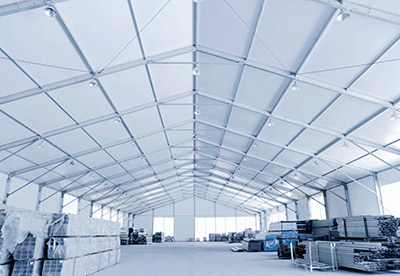
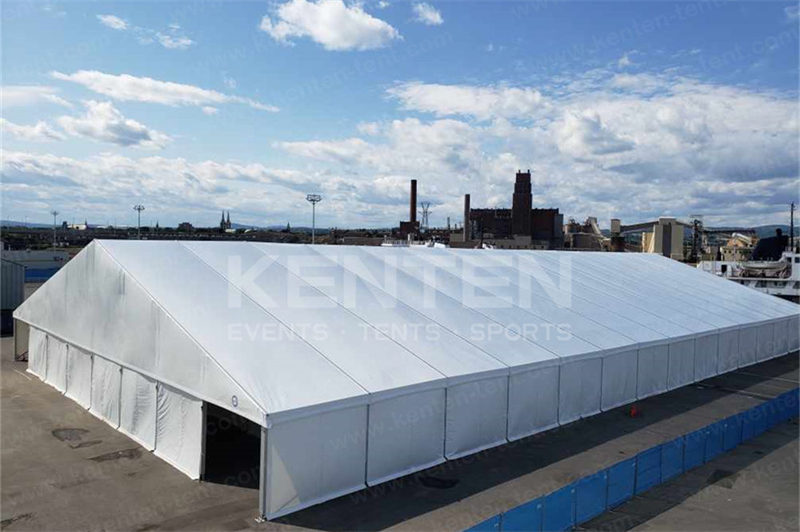
Conversely, clear-span engineered configurations eliminate internal load-bearing columns. These frameworks use high-strength extruded aluminum profiles, like 6061-T6 alloys, to transfer weight outwards to the perimeter footings. The resulting open volume provides a clean slate for spatial planning. Pallet racks can sit tightly packed against edge boundaries without structural interference. Without interior poles, standard industrial traffic moves efficiently. Forklifts can travel straight down wide aisles, turning radii expand, and workflow velocity increases.
Beyond simple vehicle navigation, a clear-span tent structure building alters the physics of the indoor environment. Airflow moves naturally across the open layout without columns causing static dead zones. This improves the performance of overhead HVAC systems. Additionally, clear-span designs improve visibility. Site supervisors gain an unobstructed view of the entire shop floor, which enhances safety and speeds up response times. The absence of internal supports turns the facility from a basic shelter into an adaptive, high-density industrial tool.
Structural Feature
Clear-Span Aluminum Frame
Pole-Supported Shelter
Internal Obstructions
None
Center poles every 3-5 meters
Perimeter Anchor Footprint
Tight, internal or flush plate
Extended guy-wires (2-3m setback)
Volumetric Air Circulation
Uniform, unobstructed paths
Fragmented by internal vertical
Heavy Machinery Compatibility
Ideal for overhead cranes/lifts
Highly restricted movement paths
Determining Dimensions for Turnkey Operations
Calculating structural dimensions requires evaluating the specific requirements of the indoor assets. The clear-span width determines the primary workflow layout. If an operation uses standard three-tier selective pallet racking, the minimum span must accommodate the racks, flue spaces, and forklift turning aisles. Standard counterbalanced forklifts require an aisle width of at least 3.5 meters to operate safely. Choosing a narrow span forces the layout into a single-line configuration, which increases inventory retrieval times.
Vertical space selection requires looking beyond floor area measurements. The eave height controls the true storage capacity of a tent structure building. In modern supply chain operations, stacking inventory vertically is much more cost-effective than expanding the building footprint. If the eave height is restricted to 4 meters, an operator cannot utilize high-bay storage. Raising the eave height to 6 or 8 meters allows for multi-tier racking networks, which can double or triple total storage capacity within the same footprint.
Engineers must also evaluate the roof pitch when choosing an eave height. A steep roof line adds interior overhead volume, which helps heat rise away from floor-level operations. However, this extra vertical space increases the building’s wind profile. Tall walls face significant lateral wind loads. High-performance modular facilities use thick aluminum profiles to handle these forces. This ensures the tent structure building maintains its engineering integrity under regional code requirements, such as IBC or EN standards.
Environmental Control and Insulation Upgrades
An industrial structure must protect sensitive inventory from external weather conditions. Raw PVC fabric envelopes can experience internal condensation during temperature shifts. When warm air inside contacts a cold single-skin fabric ceiling, dew forms and drops onto stored goods. For long-term manufacturing operations, adding environmental upgrades transforms a basic tent structure building into a climate-controlled facility.
Wall/Roof Upgrade Component
Primary Material Composition
Industrial Performance Metric
Typical Application Scenario
Sandwich Wall Panels
Rigid polyurethane core between steel sheets
High R-value thermal insulation, impact resistance
Replacing fabric sidewalls with rigid sandwich panels provides structural insulation. These panels feature a high-density polyurethane core between two steel sheets, which reduces thermal transfer. This makes it easier for HVAC units to maintain steady temperatures. For facilities located near residential areas, these solid walls also provide helpful acoustic dampening. They block loud manufacturing noises from traveling outside while keeping external weather elements isolated from the internal production lines.
Roof insulation requires a different approach. Installing a double-layer insulated roof membrane creates an air pocket that acts as a thermal buffer. This pocket reduces solar heat gain during hot summer months and keeps warm air inside during the winter. Continuous air-pumping systems maintain optimal pressure within the membrane layers, which stops the fabric from fluttering during high winds. These environmental upgrades protect sensitive machinery, keep workers comfortable, and extend the lifespan of the entire tent structure building.
Structural Execution and Deployment Strategy
A successful industrial build requires precise execution during field deployment. Organizations like KENTEN provide prefabricated, modular components that allow for rapid installation of a tent structure building on site. Because these structures can anchor directly to existing asphalt or concrete slabs without deep footings, site preparation time is minimal. This engineering approach lets companies scale up their operations quickly when market conditions change.
The choice between permanent construction and modular structural frameworks involves assessing long-term flexibility. A traditional brick-and-mortar building fixes an enterprise to a single location and footprint. An engineered aluminum clear-span tent structure building provides an adaptable alternative. It can be expanded, shortened, or completely relocated as operational needs shift. Investing in high-performance structural systems allows companies to optimize their spatial footprint while retaining long-term operational agility. Ultimately, the right tent structure building delivers both immediate capacity gains and sustained operational resilience.


 HIGH-END SERIES
 STRUCTURE TENTS
 ACCESSORIES