Home » Aluminium Pagoda Tent: Structural Logic Behind a Modern Clear-Span Roof
Aluminium Pagoda Tent: Structural Logic Behind a Modern Clear-Span Roof
July 4, 2026
Event organizers rarely have the luxury of building permanent structures for a three-day exhibition or a single product launch. An aluminium pagoda tent solves that gap directly — it delivers a rigid, weatherproof enclosure without the cost or time of conventional construction. The pointed roof geometry isn’t decorative flair alone; it’s a load path that sheds rain and channels wind stress toward the frame corners, which matters when a site has no fallback plan if the structure fails mid-event.
Why the Pointed Roof Matters Structurally
A pyramid-style roof distributes vertical and lateral loads differently than a flat or arched span. Water runs off faster, snow accumulation is reduced on the steep pitch, and the peak point transfers force efficiently into the four corner legs. For planners working outdoor security checkpoints or press events where downtime isn’t an option, this geometry reduces the risk of ponding or fabric sag that plagues flatter tent designs.
Frame Engineering and Connection Points
The frame relies on hard-pressed extruded 6061-T6 aluminium alloy, formed into a four-channel profile that resists twisting under uneven loading — a common failure mode in cheaper tube-and-coupler systems. Hot-dip galvanized steel inserts join the aluminium sections, preventing the corrosion that untreated steel connectors develop after repeated outdoor cycles.
This connection detail is where most tent failures actually originate, not in the fabric. A loose or corroded joint under wind load can propagate stress into the entire bay, so the insert-and-bolt method matters more than most buyers initially assume when comparing tent quotes.
Wind and Weather Performance in Practical Terms
Rated for wind resistance between 80 and 100 km/h, the structure is built for open-field exposure — parking lots, stadium perimeters, desert sites — where there’s no windbreak from surrounding buildings. The PVC-coated polyester cover, weighing 800–950 g/m² on the roof and 650 g/m² on the sidewalls, is flame-retardant and UV-stabilized, addressing two separate degradation paths: sun exposure breaking down fiber and open flame risk in crowded venues.
Technical Specifications at a Glance
Specification
Detail
Frame Material
6061-T6 extruded aluminium, 4-channel profile
Connectors
Hot-dip galvanized steel insert
Roof Cover
Opaque PVC, 800-950 g/m²
Sidewall Cover
Translucent PVC, 650 g/m²
Wind Resistance
80-100 km/h
Temperature Range
-30°C to +70°C
Widths Available
3m, 4m, 5m, 6m, 8m, 10m
Standard Side Height
4m (2.5m-3.5m on request)
Service Life
15+ years
Clear-Span Interior and Modular Sizing
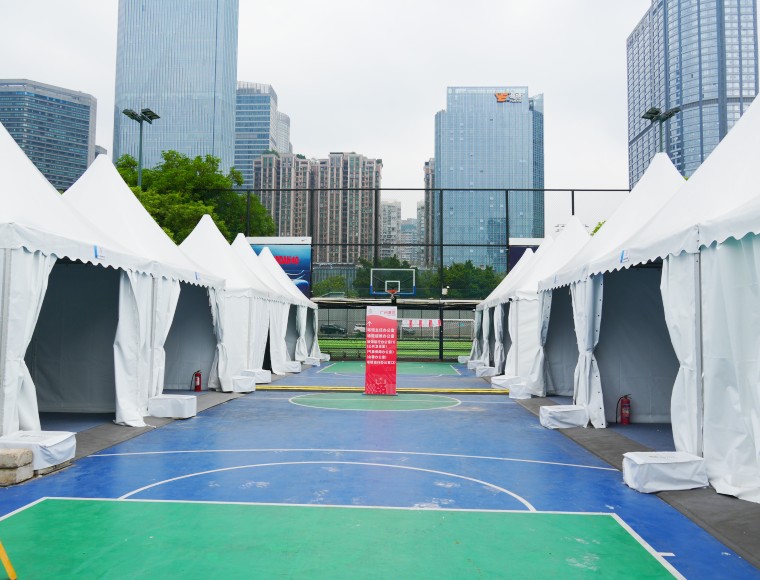
Because the design eliminates internal support poles, the entire floor area stays usable — critical for exhibition booths where every square meter carries sponsor value, or medical stations where staff need unobstructed movement around equipment. Widths from 3m to 10m let planners scale a single unit or link multiple bays into a continuous run, which explains why these tents appear in symmetrical rows at large sporting events rather than as isolated units.
Where This Structure Actually Gets Used
Historical deployment patterns tell you more than a spec sheet. Pagoda-style tents have served as spectator checkpoints, medical stations, and press facilities at major international sporting events, alongside smaller-scale uses:
Private celebrations and outdoor parties
Media and press events
Exhibition booths and product showcases
Brand promotions and vehicle launches
Temporary security checkpoints
Sports event infrastructure
The same frame that supports a car launch backdrop also holds up under 15,000-person crowd flow at a checkpoint — the difference is branding, not engineering.
Assembly Considerations for Tight Timelines
A modular, lightweight aluminium frame allows installation by a small crew without cranes or heavy machinery. For event sites with narrow load-in windows — convention centers with strict dock schedules, or public plazas with limited vehicle access — this reduces both labor cost and the liability window during setup.
Frequently Asked Questions
Does the roof pitch affect interior height usability?
No. The peak rises above the usable floor area, so standard side heights of 4m remain the functional ceiling for booths, lighting rigs, and signage.
Can these tents handle snow load, not just wind?
The steep pitch reduces accumulation, though snow load capacity depends on regional structural codes and should be confirmed against local requirements before winter deployment.
Is the PVC cover suitable for long-term semi-permanent use?
With a rated service life over 15 years and UV/flame-retardant treatment, the fabric holds up under extended exposure, though periodic inspection of seams is standard practice regardless of tent brand.
How do multiple units connect for larger footprints?
Standard width increments (3m through 10m) allow bays to link along shared frame lines, which is how large-scale checkpoint and exhibition layouts are typically configured.
For teams comparing structures across climates and event types, an aluminium pagoda tent offers a documented balance of wind rating, modular sizing, and connection durability — details worth checking against your site’s actual exposure before signing off on any semi-permanent installation.


 HIGH-END SERIES
 STRUCTURE TENTS
 ACCESSORIES