Home » Applications of Igloo Structure in Sports Events
Applications of Igloo Structure in Sports Events
May 20, 2026
Rethinking Ice Sports Infrastructure in a Global Event Economy
Ice sports have entered a new phase of global expansion. Once concentrated in traditional winter regions, disciplines such as ice hockey and figure skating are now actively developing across Asia, the Middle East, and emerging markets in Europe. This shift is driven not only by professional leagues, but also by international governing bodies seeking to globalize participation and commercial reach. Events such as the Winter Olympics, the IIHF World Championship, and the ISU World Figure Skating Championships represent the highest level of competition and global visibility. At the same time, leagues like the National Hockey League continue to expand their international footprint through overseas games, fan events, and temporary installations. However, behind this growth lies a structural challenge. Traditional ice arenas require heavy civil construction, permanent land allocation, and long development cycles. For many cities and event organizers, this creates a mismatch between infrastructure investment and actual usage. Seasonal demand, rotating event calendars, and evolving urban planning priorities all require a more flexible approach. KENTEN Igloo Structure is developed in response to this reality. It is not simply a temporary enclosure, but a modular, engineered ice sports environment designed to deliver professional performance, rapid deployment, and long-term adaptability. It represents a shift from fixed infrastructure to dynamic venue systems—capable of supporting both global events and local development strategies.
Why Form Matters in Ice Sports
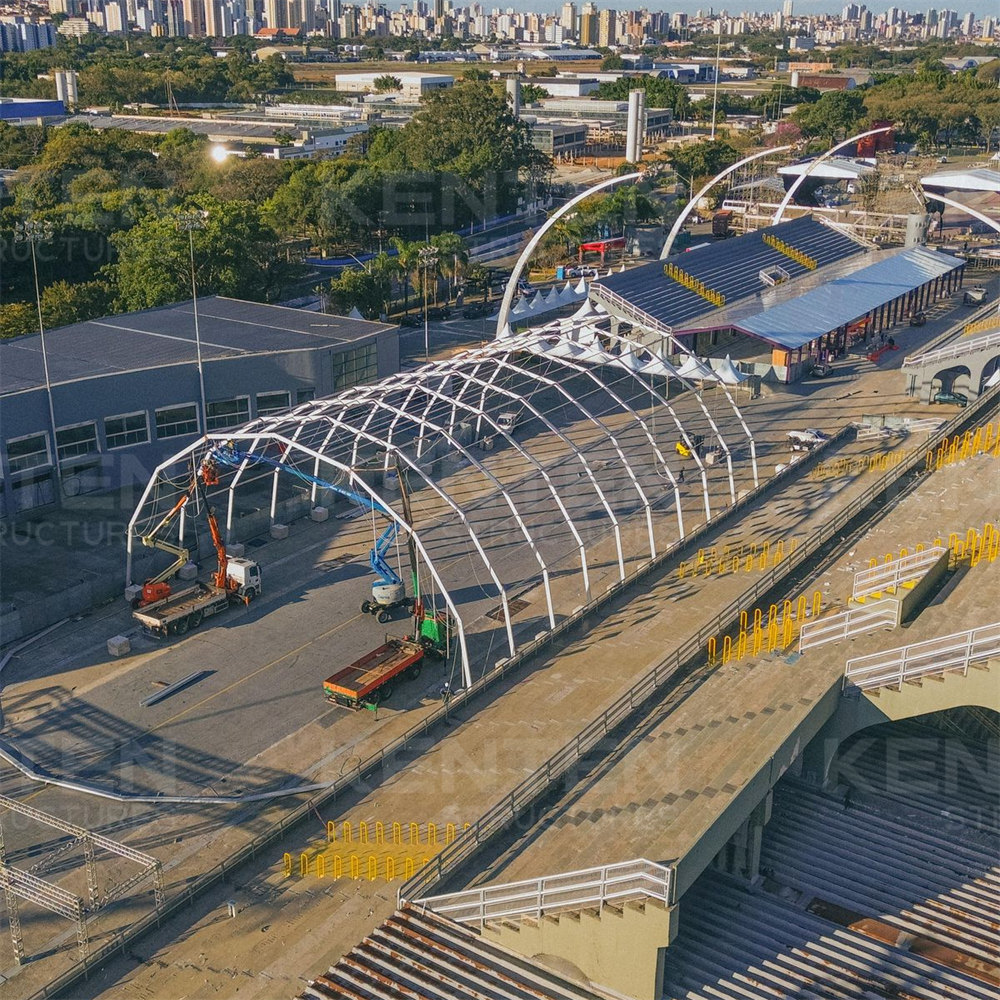
In modern sports, the venue is no longer a passive shelter. It is part of the narrative, part of the broadcast, and part of the commercial identity of the event. KENTEN Igloo Structure is defined by its semi-dome curved geometry—an architectural language that immediately distinguishes it from conventional tent systems or industrial sheds. This is particularly important in ice sports, where visual clarity, lighting reflection, and spatial perception directly influence both athlete performance and audience experience. For international competitions such as the Winter Olympics, venue design plays a critical role in storytelling. Broadcast visuals are consumed by millions globally, and the architectural silhouette becomes part of the event’s identity. The flowing form enhances aerial shots, strengthens nighttime illumination effects, and creates a recognizable landmark—even in temporary or remote locations. Beyond aesthetics, the geometry is engineered for performance. Snow load distribution is optimized, wind resistance is improved, and internal height is maximized without introducing structural complexity. This is essential for ice hockey puck trajectories, figure skating lifts, and overhead broadcast rigging. The result is a structure that reads as architecture—not as a temporary solution—while maintaining the flexibility required for modern event delivery.
Engineered Space for Ice Hockey and Figure Skating
Ice sports require precision environments. From rink dimensions to vertical clearance and climate stability, every element must meet strict international standards. KENTEN Igloo Structure delivers clear-span interiors of up to 70 meters, eliminating internal columns and ensuring uninterrupted ice surfaces. This is critical for professional ice hockey, where gameplay speed and spatial awareness demand complete visual openness, and equally important for figure skating, where choreography extends across the full rink without obstruction. The structure supports modular length extensions, allowing operators to configure single or multiple ice sheets depending on program requirements. This flexibility enables a wide range of applications—from elite competition venues to training academies and public skating facilities. The use of 6061/T6 high-strength aluminum alloy ensures structural integrity while maintaining lightweight efficiency. Engineered to meet European and North American standards, the system provides confidence for federations, event organizers, and commercial operators seeking compliance and reliability. With a service life of up to 20 years, KENTEN Igloo Structure occupies a unique position between temporary and permanent infrastructure—offering durability without sacrificing adaptability.
How Global Ice Events Are Expanding Through Temporary Venues
A notable trend in international ice sports is the increasing use of flexible venues to expand geographic reach. The Winter Olympics has demonstrated how temporary and semi-permanent venues can reduce post-event redundancy while maintaining world-class competition standards. Similarly, the NHL has introduced outdoor and international games that bring ice hockey into new markets, often relying on engineered temporary structures to create controlled environments. Figure skating events, including the ISU World Championships, also benefit from adaptable venues that can be tailored to specific host cities. Lighting, acoustics, and audience proximity all play a role in shaping the presentation of the sport. KENTEN Igloo Structure aligns with these trends by enabling rapid deployment of broadcast-ready ice arenas. Within a controlled enclosure, organizers can integrate branding, lighting design, and media infrastructure to deliver a consistent global standard—regardless of location. This approach allows events to travel more freely, reach new audiences, and activate cities that previously lacked the infrastructure to host high-level competitions.
Climate Control: The Foundation of Ice Quality
At the core of any successful ice facility is environmental control. Ice quality is highly sensitive to temperature fluctuations, humidity levels, and air circulation. KENTEN Igloo Structure integrates advanced HVAC systems and insulation solutions to maintain stable internal conditions. This ensures consistent ice thickness, surface quality, and athlete safety across different climates—from cold northern regions to warm urban environments. The ability to operate independently of external weather conditions is particularly valuable for event organizers. It reduces the risk of schedule disruption, ensures broadcast reliability, and enhances overall operational predictability. For training facilities and academies, it enables year-round programming, transforming ice sports from seasonal activities into continuous business models.
A Flexible Investment Model for Public and Private Stakeholders
Infrastructure decisions are increasingly driven by financial logic as much as by technical requirements. For municipalities, investing in a permanent ice arena may not always align with long-term urban planning or budget constraints. KENTEN Igloo Structure offers an alternative model—one that reduces initial capital expenditure, shortens construction timelines, and allows for future reconfiguration or relocation. This flexibility enables cities to respond to immediate needs, such as hosting regional tournaments or supporting youth development programs, without committing to irreversible investments. For private operators, the structure supports scalable business growth. Facilities can be expanded as demand increases, and operational costs can be aligned with revenue generation. The ability to reuse and redeploy the structure further enhances return on investment. In both cases, KENTEN Igloo Structure transforms infrastructure from a fixed cost into a strategic asset.
Commercial Activation and Event Experience
Modern sports venues are no longer defined solely by competition. They function as platforms for brand engagement, media production, and audience experience. KENTEN Igloo Structure supports this by creating an immersive internal environment where lighting, acoustics, and spatial design can be fully controlled. During daytime events, natural light can be utilized to reduce energy consumption while maintaining visual clarity. At night, the illuminated structure becomes a glowing landmark, enhancing both live experience and broadcast appeal. For sponsors and event partners, this creates new opportunities for branding integration. The structure itself becomes part of the visual identity, reinforcing recognition across digital and broadcast channels. This is particularly relevant for high-profile events such as the Winter Olympics or NHL international games, where global visibility translates directly into commercial value.
Spatial Organization for Professional Ice Facilities
Beyond the ice surface, a professional venue requires a carefully structured operational ecosystem. KENTEN Igloo Structure allows for flexible internal zoning, enabling the integration of athlete preparation areas, locker rooms, technical control spaces, and media zones within a coherent spatial framework. The modular design ensures that these functions can be configured without compromising the clarity of the main structure. Circulation paths can be optimized for athletes, staff, and spectators, ensuring efficient movement and operational flow. This approach transforms the structure into a complete venue environment—capable of supporting complex events and multi-layered programming.
Sustainability and Lifecycle Efficiency
As sustainability becomes a central consideration in infrastructure planning, the ability to minimize environmental impact while maintaining performance is critical. KENTEN Igloo Structure addresses this through its modular design and reusable materials. Aluminum components can be disassembled and redeployed, reducing construction waste and extending lifecycle value. Compared to traditional concrete arenas, the structure requires less material, less foundation work, and less energy-intensive construction processes. This contributes to lower embodied carbon and aligns with ESG objectives increasingly adopted by governments and organizations worldwide. In this sense, KENTEN Igloo Structure is not only a technical solution, but also a responsible one.
More Real Life Applications
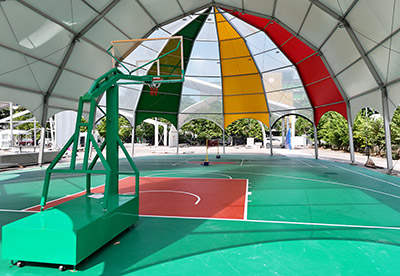
Basketball and volleyball courts
Badminton and tennis centers
Soccer(Football) or Rugby(American Football) fields
Padel and pickleball training
Swimming pools
Fitness training and physical education classes
Multi-purpose community sports events
Conclusion: The Future of Ice Sports Infrastructure
The global growth of ice sports demands a new type of infrastructure—one that is flexible, scalable, and capable of delivering professional standards in diverse environments. KENTEN Igloo Structure represents this evolution. It combines engineering precision, architectural identity, and operational intelligence into a single system designed for modern ice sports. From international events like the Winter Olympics and IIHF World Championship to regional development programs and commercial ventures, it enables a broader participation in the ice sports ecosystem. It allows cities to host without overbuilding, operators to grow without overcommitting, and events to expand without limitations. In doing so, it redefines the role of sports architecture—from static construction to dynamic infrastructure that evolves with the game.
Contact KENTEN to explore how an igloo structure can support your next ice hockey arena, figure skating venue, or global winter sports event.


 HIGH-END SERIES
 STRUCTURE TENTS
 ACCESSORIES