Home » Aerodynamic and Mechanical Performance of Curved Tension Fabric Structures
Aerodynamic and Mechanical Performance of Curved Tension Fabric Structures
June 5, 2026
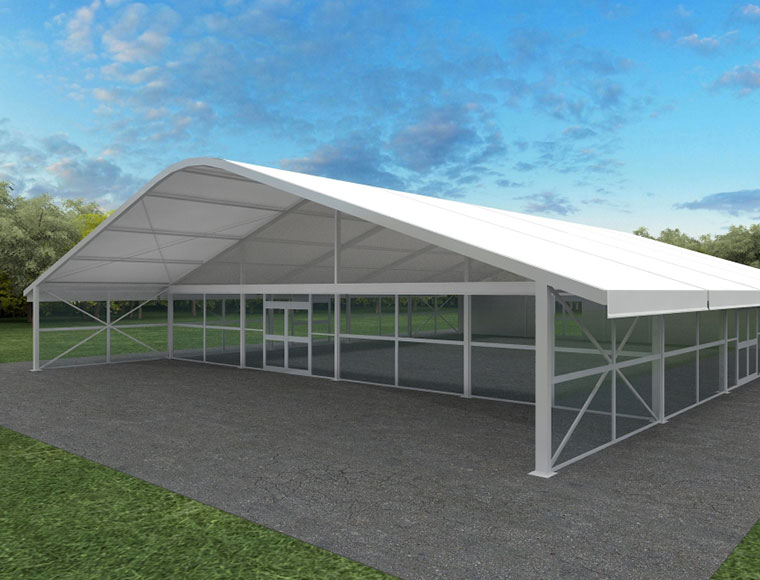
The demand for reliable, long-lasting temporary enclosures has driven architectural innovation toward highly resilient engineering designs. Among these, the curved tension fabric structure stands out as an exceptional solution for large-scale operations requiring shelter without interior barriers. Unlike traditional pitched roofs, a curved tension fabric structure provides a streamlined aerodynamic profile that mitigates wind drag and sheds environmental loads with exceptional efficiency. This structural design serves as a robust permanent structure tent alternative, offering a unique blend of structural longevity and modular flexibility for demanding professional environments.
Aerodynamics of Curved Roof Profiles Under Wind Loads
In structural engineering, the geometry of an enclosure dictates how it interacts with boundary-layer wind forces. Pitch-roofed systems experience significant localized windward pressure and severe leeward turbulence, which increases structural stress on the frame joints. In contrast, the curved profile of this tension fabric structure promotes a smoother, laminar airflow pattern across the canopy, which reduces overall drag coefficient by up to thirty percent.
This aerodynamic behavior is critical when deploying a permanent structure tent configuration in coastal regions or wide plains. When high winds hit the curved rafters, the aerodynamic lift is evenly distributed rather than concentrated at a single ridge peak. By transforming wind resistance from a concentrated impact into distributed shear stress, the curved framing ensures high structural stability without requiring excessive dead weight.
Mechanical Engineering and Material Integrity
To achieve a twenty-year frame service lifespan, the structural core must rely on premium material selection and advanced fabrication standards. The primary structural components are constructed from hard-pressed extruded aluminum alloy, specifically 6061-T6 or 6082-T6, with an anodized surface treatment to prevent oxidation. This alloy delivers a yield strength comparable to structural steel while weighing only a fraction of the mass, making rapid logistics and assembly feasible.
The structural canopy utilizes high-performance polyester textile coated with dual-layer polyvinyl chloride (PVC). Weighing between 750 to 900 grams per square meter, this membrane is tensioned across the curved profiles to eliminate fabric flapping, which otherwise causes fatigue wear. This tension fabric system meets international safety standards including DIN 4102 B1 and M2 flame retardancy, and remains physically stable in temperatures ranging from -30°C to +70°C.
Technical Specification Component
Engineering Value and Material Standard
Main Frame Material
Hard-Pressed Extruded Aluminum Alloy 6061/T6 or 6082/T6
Canopy Membrane Weight
750 g/m² to 900 g/m² Double PVC-Coated Polyester
Tested Wind Resistance
80 km/h to 120 km/h
Operation Temperature
-30°C to +70°C continuous endurance
Structural Fixing Solutions
Ground anchors, expandable anchor bolts, or weight plates
Structural Behavior Under Snow Loads
Under heavy snowfall, traditional gabled roofs rely entirely on gravity and slope angle to shed snow. When snow becomes wet and dense, a flat or poorly pitched surface experiences severe dead loads that can cause local structural deformation. The curved tension fabric structure resolves this through continuous tension and curved rafter profiles.
The double-curved curvature prevents snow accumulation by encouraging immediate slippage. Furthermore, the high-tension PVC fabric remains perfectly taut, ensuring no pockets can form where water or melting ice could pool. For applications such as heavy industrial warehousing or bulk storage, this self-cleaning behavior ensures uninterrupted operations.
Operational Scenarios and Deployment
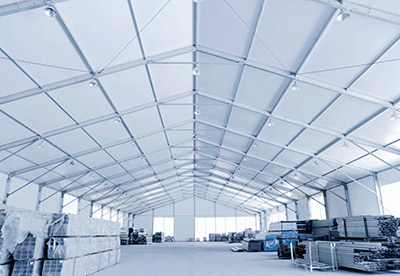
In professional environments, spatial requirements are rarely static. A logistics hub may need rapid warehouse expansion, or a port authority might require a relocatable maintenance hangar for cargo vehicles. Standard clear-span modular widths from 10.00 meters to 60.00 meters allow operators to scale their facility as demand dictates.
Because there are no interior support columns, 100% of the interior footprint is usable, allowing heavy machinery, forklifts, and storage racks to operate without physical obstacles. It is in these settings that the curved tension fabric structure functions as a reliable permanent structure tent system. It bridges the gap between temporary fabric shelters and costly concrete facilities, offering a fast, certified solution to volatile spatial challenges.
Architectural Engineering Queries
Can a curved tension fabric structure withstand localized seismic events? Aluminum frames are inherently flexible compared to rigid brick-and-mortar buildings. The high strength-to-weight ratio allows the frame to absorb kinetic seismic waves without brittle fracturing, while the tensioned fabric acts as a structural diaphragm that dampens vibrations.
How does the PVC cover behave under long-term solar UV exposure? The fabric covers are treated with advanced UV stabilizers and an acrylic top-coating on both sides. This coating prevents ultraviolet radiation from degrading the polymer chains, maintaining tensile strength and color stability over decades of direct exposure.
Is specialized heavy machinery required for structural installation? While a crane is recommended for hoisting the arched rafters on wide-span configurations (above 30 meters), the modular bay spacing design allows standard telescopic forklifts and basic hand tools to complete the assembly quickly.
For industrial and commercial operators seeking long-term shelter solutions, the curved design offers unparalleled resilience. As a modern permanent structure tent alternative, it balances advanced aerodynamics, robust material engineering, and modular convenience to deliver high-performance architecture anywhere in the world.


 HIGH-END SERIES
 STRUCTURE TENTS
 ACCESSORIES