Home » Igloo Tent: Why Festival Venues Are Becoming Part of the Music Experience
Igloo Tent: Why Festival Venues Are Becoming Part of the Music Experience
September 4, 2026
How KENTEN Igloo Structure Tent Temporary Event Space into Immersive Festival Architecture
For decades, the role of a festival venue was relatively straightforward: provide enough covered space for a stage, equipment and an audience.
That definition is becoming increasingly limited.
Modern music festivals and grand carnivals are increasingly designed as complete sensory environments. Music is only one part of the experience. Architecture, lighting, sound, visual effects, crowd movement, branding and atmosphere work together to determine how people perceive the event.
In this environment, the venue itself is becoming part of the performance.
The structure is no longer simply the place where music happens.
It helps shape how the music is experienced.
This shift is particularly visible in temporary festival architecture, where organizers have greater freedom to create environments that would be difficult to achieve with conventional permanent buildings. Temporary structures can introduce new architectural forms into open sites, create immersive destinations within large festival grounds and transform their appearance throughout the day.
Research into temporary festival performance spaces has similarly identified atmosphere, sound quality, uniqueness and audience participation as important factors in how a performance environment is experienced.
KENTEN Igloo Structure provides an example of this evolution.
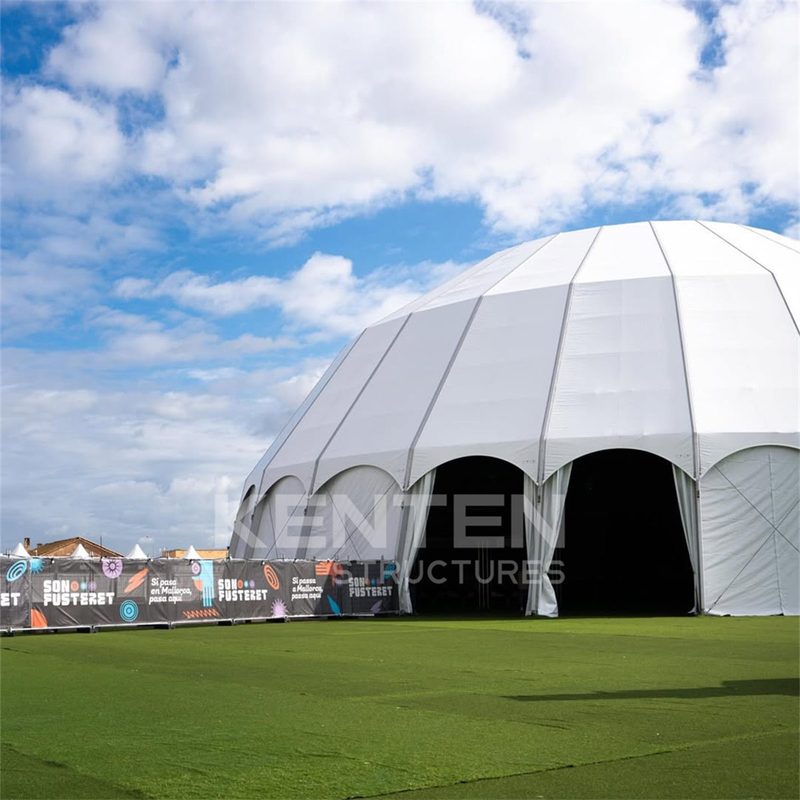
With its continuous arch geometry, large clear-span interior and potential for transparent enclosure systems, it can function not simply as a temporary covered venue, but as an architectural environment designed around the relationship between music, space and audience experience.
The Venue Is Becoming Part of the Performance
A festival audience does not experience music in isolation.
The perception of a live performance is influenced by everything surrounding it: the scale of the venue, the movement of people, the quality of the sound environment, the lighting, the visibility of the stage and the atmosphere created inside the space.
This makes the physical venue an active part of the experience.
A conventional temporary structure may provide the necessary footprint and weather protection. But a more carefully designed structure can influence the audience’s perception before the performance even begins.
The structure establishes the transition from the outdoor festival site into the performance environment.
That transition matters.
It creates anticipation.
It separates one experience from another.
It gives the audience a physical sense that they are entering somewhere different.
This is one reason temporary architecture, such as KENTEN Igloo Structure, has become an increasingly important component of festival design. Recent festival projects have used temporary structures not only for practical functions, but also as spatial landmarks, interactive environments and destinations for audiences.
From EventTent to Experience Architecture
The traditional definition of a tent focuses on physical performance:
Span. Capacity. Weather protection. Installation.
These remain essential.
But high-impact festival venues have another dimension:
Perception.
How does the space feel when someone enters?
How does it look from across the festival grounds?
How does daylight change the interior?
What happens when lighting systems are activated after sunset?
How does the architecture interact with sound, stage design and crowd movement?
These questions move temporary structures closer to the field of experience architecture.
KENTEN Igloo Structure is particularly suited to this approach because its architectural geometry creates a different visual language from conventional rectangular event structures.
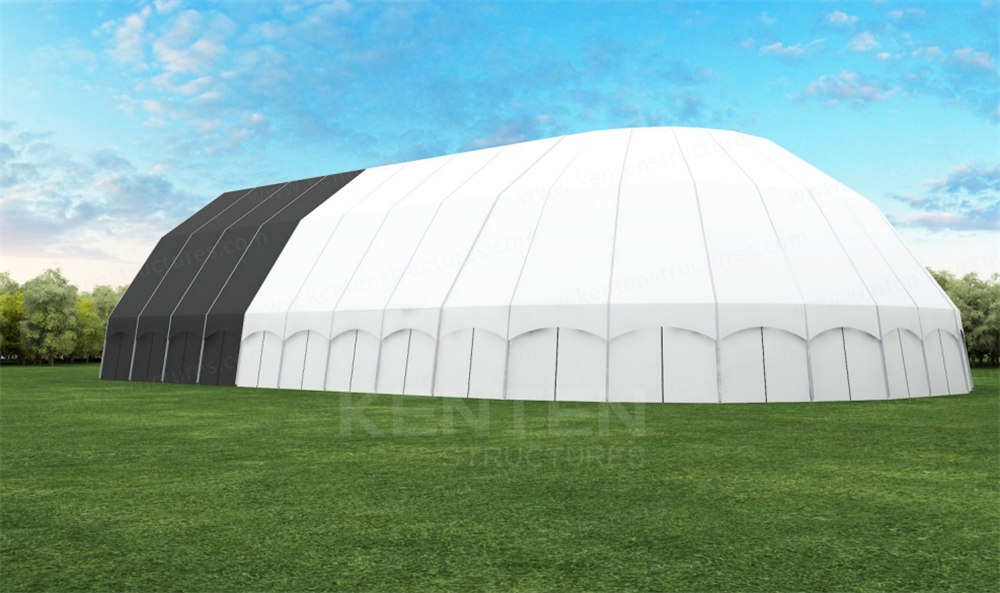
The continuous arch system produces a recognizable volume that can become a visual destination within the festival site.
The result is not simply a larger tent.
It is a space with an architectural identity.
KENTEN Igloo Structure: Creating a Distinctive Festival Environment
KENTEN Igloo Structure is built around continuous arch frames that create a stable structural network while maintaining a large, unobstructed interior.
For festival applications, this combination of structural performance and spatial openness provides several advantages.
The clear-span environment gives event designers greater freedom to organize:
Stage configurations
Audience areas
Dance floors
Bars
Technical equipment
Lighting systems
Visual installations
VIP zones
Circulation paths
Without intrusive internal columns, the structure can remain visually open from one side of the venue to the other.
This is important for both production and audience experience.
From the production perspective, stage and technical layouts can be organized around the requirements of the event.
From the audience perspective, the uninterrupted volume can contribute to clearer sightlines and a stronger sense of spatial continuity.
The structure therefore provides the physical framework.
The event design determines what happens inside it.
Architecture and MusicShall Work Together
A festival venue should not be designed independently from the performance taking place inside it.
Music has spatial characteristics.
A DJ performance, electronic music experience, live concert, cultural performance and large-scale carnival show may each require a different relationship between audience and performer.
The architectural environment needs to accommodate those differences.
An immersive electronic music venue may benefit from a controlled interior atmosphere where lighting, LED content and sound create a concentrated experience.
A live concert may require a large audience volume with strong sightlines toward the stage.
A cultural carnival installation may place greater emphasis on visual interaction, movement and architectural identity.
The structure shall therefore be flexible enough to support different event concepts without becoming visually generic.
KENTEN Igloo Structure provides a modular structural platform that can be adapted to project-specific layouts and event requirements.
The same fundamental architectural language can support very different experiences.
Clear-Span Space Creates Freedom for Festival Production
Large-scale festival production increasingly depends on complex technical systems.
Lighting rigs, sound systems, LED screens, stage equipment and suspended visual elements can become integral to the experience.
This makes interior structural planning critical.
A clear-span environment eliminates the need to work around internal support columns and creates greater freedom for stage positioning and audience organization.
For production teams, this can simplify the relationship between the venue and the event’s technical systems.
KENTEN Igloo Structure becomes a large spatial envelope around which the production environment can be designed.
This is particularly valuable when the venue itself is intended to create an immersive experience rather than simply provide a roof over an existing stage.
In this context, structural capacity and creative freedom are closely connected.
The more efficiently the structure uses its interior volume, the more possibilities become available to the event designer.
Transparency Changes the Relationship Between Inside and Outside
One of the powerful ways to change the experience of a temporary structure is through its envelope.
An opaque structure establishes a strong boundary between the festival and the interior.
A transparent or visually open enclosure creates a different relationship.
With transparent PVC or suitable glazing solutions, natural light can enter the structure during the day while the interior remains visually connected with the surrounding site.
The result is an environment that feels less isolated from its surroundings.
For festivals, this can be particularly valuable when the site itself is part of the visual experience.
Rather than completely separating the audience from the outside world, the structure can frame it.
This approach has been demonstrated in KENTEN Igloo Structure festival applications, where transparent PVC has been used to soften the boundary between interior and exterior and create a stronger relationship between daylight, architecture and audience perception.
When Daylight Becomes Part of the Architecture
The same structure can produce a completely different atmosphere after sunset.
During the day, the enclosure can interact with natural light.
At night, artificial lighting can reverse the relationship.
Instead of light entering the structure, light begins to emerge from it.
The architecture can become a luminous element within the festival landscape.
This creates a powerful day-to-night transformation:
Day
Natural light → Transparent envelope → Open visual atmosphere
It can help establish identity, improve visual orientation across a large event site and create a recognizable backdrop for photography and video.
For contemporary festivals, this matters because the event continues to exist visually beyond the physical venue. Images and videos become part of how the event is remembered and shared.
KENTEN Igloo Structure that has a recognizable architectural identity can therefore contribute to the event’s visual language.
The building becomes content.
The Architecture Can Become a Festival Landmark
Large festivals can occupy substantial outdoor areas.
When visitors move between stages, food areas, lounges and entertainment zones, recognizable structures can help create a sense of place.
This is where the concept of destination architecture becomes relevant.
A structure does not have to be the main stage to become memorable.
It can become:
The place where people meet.
The place where a particular artist performs.
The place where a sponsor creates an experience.
The place people photograph.
The place visitors remember after the festival.
KENTEN Igloo Structure can provide this architectural identity through its distinctive form and configurable envelope.
Instead of blending into the background, the structure can establish a recognizable destination within the wider festival landscape.
This creates a different relationship between architecture and event programming.
The festival does not simply contain structures.
The structures help organize the festival experience.
One Structure, Multiple Experiences
A modern festival venue may need to operate differently at different moments.
During the afternoon, the space may function as a relaxed gathering environment.
Later, it may become a performance venue.
After dark, lighting and audiovisual systems can transform it into an immersive entertainment environment.
Outside the headline performance, it may support:
Dining
Bar Service
Brand Activation
VIP Hospitality
Artist Events
Private Gatherings
This makes the temporary venue more valuable when its design is based on adaptability rather than a single fixed use.
KENTEN Igloo Structure provides a large modular volume that can be organized around these changing requirements.
The structure provides continuity.
The programming provides transformation.
Why Modularity Matters to Festival Architecture
Festivals are rarely identical from one edition to the next.
The location may change.
The audience profile may change.
The program may change.
The available footprint may change.
Even the desired experience may evolve.
This makes modularity particularly valuable.
A modular structure, like KENTEN Igloo Structure, can be planned around the available site and configured according to the intended function. Its lifecycle can also extend beyond a single event, allowing the structure to be dismantled, transported and potentially redeployed for future projects, subject to the specific engineering configuration and operating conditions.
This creates a different model of temporary architecture.
Instead of designing a permanent building for one fixed location, organizers can develop a reusable structural platform capable of supporting different event environments over time.
The architecture becomes temporary in location, but potentially long-term in value.
KENTEN Igloo Structure vs. Conventional Festival Structures
Consideration
Conventional Event Structure
Permanent Venue
KENTEN Igloo Structure
Primary Role
Temporary event coverage
Fixed performance venue
Temporary architectural performance environment
Architectural Identity
Primarily functional
Permanent site identity
Distinctive modular architectural form
Interior Space
Depends on system
Fixed after construction
Large clear-span environment
Stage Planning
Adaptable within structural limits
Determined by permanent design
Flexible within project-specific structural planning
Audience Experience
Primarily event-focused
Defined by permanent architecture
Structure can actively contribute to event atmosphere
Day-to-Night Transformation
Usually dependent on event decoration
Permanent systems
Envelope, lighting and interior systems can transform the environment
Visual Connection
Depends on enclosure
Determined by building design
Transparent or visually open solutions can connect inside and outside
Deployment
Temporary installation
Long construction process
Modular temporary deployment
Future Adaptation
Often limited
Limited without renovation
Potential for reconfiguration and redeployment
Festival Branding
Applied to structure
Integrated into building
Architecture and envelope can become part of event identity
The key difference is not simply structural form.
It is the role the structure plays in the event.
A conventional event structure primarily provides space.
A permanent venue provides a fixed architectural environment.
KENTEN Igloo Structure sits between these models: a temporary, modular structure that can be engineered to provide both functional performance and architectural presence.
Designing the Venue Around the Audience
The ultimate purpose of festival architecture is not the structure itself.
It is the experience created for the people inside it.
This means event designers need to consider how audiences:
Approach the venue
Recognize the destination
Enter the structure
Discover the interior
Interact with the performance
Move through the space
Leave with a memorable experience
Every stage of this journey can be influenced by architecture.
The entrance can create anticipation.
The interior volume can establish atmosphere.
The clear-span layout can improve visibility.
The envelope can control the relationship with daylight and the surrounding festival.
Lighting can transform the structure after dark.
The result is an environment where KENTEN Igloo Structure supports music.
From Temporary Venue to Experiential Infrastructure
The evolution of festival architecture reflects a broader change in the event industry.
Temporary structures are increasingly expected to deliver more than speed and coverage.
They are expected to provide:
Function
Flexibility
Comfort
Architectural Identity
Technical Integration
Audience Engagement
This is particularly important for music festivals and grand carnivals, where the physical environment becomes part of the cultural and emotional experience.
The strongest festival venues do not simply accommodate the audience.
They shape how the audience experiences the event.
KENTEN Igloo Structure provides a platform for this approach.
Its continuous arch structure creates a large clear-span interior. Its modular configuration allows the venue to respond to project-specific requirements. Transparent or visually open enclosure solutions can strengthen the relationship between the interior and the surrounding site. And with integrated lighting and event production, the structure can transform from a daytime architectural volume into a luminous nighttime destination.
This combination allows temporary infrastructure to become something more: a temporary architectural environment designed around the experience of music, people and place.
Conclusion: The Venue Is Now Part of the Music
The future of festival architecture will not be defined only by larger stages, higher capacities or more sophisticated production systems.
It will also be defined by the spaces between the performance and the audience.
Architecture can create anticipation before the music begins.
It can shape atmosphere while the performance is happening.
It can connect the audience with the surrounding landscape.
It can become a landmark after sunset.
And it can create the physical environment where people gather, interact and remember the event.
This is why festival venues are becoming part of the music experience.
KENTEN Igloo Structure represents this evolution through a combination of modular engineering, clear-span spatial planning and distinctive architectural form.
For music festivals, grand carnivals, immersive performances, brand activations and large-scale entertainment events, it provides a way to create temporary venues that do more than contain an event.
They help define it.
When architecture becomes part of the experience, the temporary venue becomes part of the story.
FAQ
What makes a festival venue part of the music experience?
A festival venue becomes part of the experience when its architecture, spatial organization, lighting, sound environment, visual identity and relationship with the audience contribute directly to how the performance is perceived.
What is KENTEN Igloo Structure?
KENTEN Igloo Structure is a modular temporary structure based on continuous arch frames that create a large clear-span interior. It can be configured for applications including music festivals, immersive performance spaces, brand activations, hospitality and other large-scale temporary events.
Why is clear-span space important for music festivals?
A clear-span interior minimizes internal structural obstructions and gives production teams greater freedom when arranging stages, audience zones, technical equipment, lighting and circulation.
Can KENTEN Igloo Structure be used for immersive music experiences?
Yes. Its large enclosed volume and distinctive architectural geometry can provide a strong foundation for immersive music environments. Lighting, audiovisual systems, interior design and the selected envelope can further shape the atmosphere of the venue.
Can KENTEN Igloo Structure be transparent?
Yes. KENTEN Igloo Structure can be configured with transparent PVC or other suitable enclosure solutions depending on project requirements. Transparent systems can increase daylight and strengthen the visual relationship between the interior and the surrounding festival site.
How does KENTEN Igloo Structure change at night?
With appropriate lighting and event production systems, KENTEN Igloo Structure can take on a different visual character after sunset. Interior illumination can make the building itself a visible element within the festival landscape, helping create a recognizable nighttime destination.
Can KENTEN Igloo Structure support different festival functions?
Yes. Depending on the project, KENTEN Igloo Structure can be configured for performance, audience areas, bars, lounges, dining, brand activation, VIP experiences or other event functions.
Is KENTEN Igloo Structure suitable for grand carnivals?
Yes. The distinctive architectural form can be used to create cultural venues, entertainment spaces, public gathering areas, branded environments and architectural landmarks within large carnival sites.
Can KENTEN Igloo Structurebe expanded or redeployed?
Yes. The modular approach allows project-specific configuration and can support potential future expansion, dismantling, transportation and redeployment, subject to structural design, site conditions and the requirements of each project.
Is KENTEN Igloo Structure suitable for a premium festival?
Yes. With appropriate structural engineering, enclosure systems, interior design, lighting, HVAC and audiovisual integration, KENTEN Igloo Structure can create a premium event environment with architectural character and high levels of functional flexibility.


 HIGH-END SERIES
 STRUCTURE TENTS
 ACCESSORIES