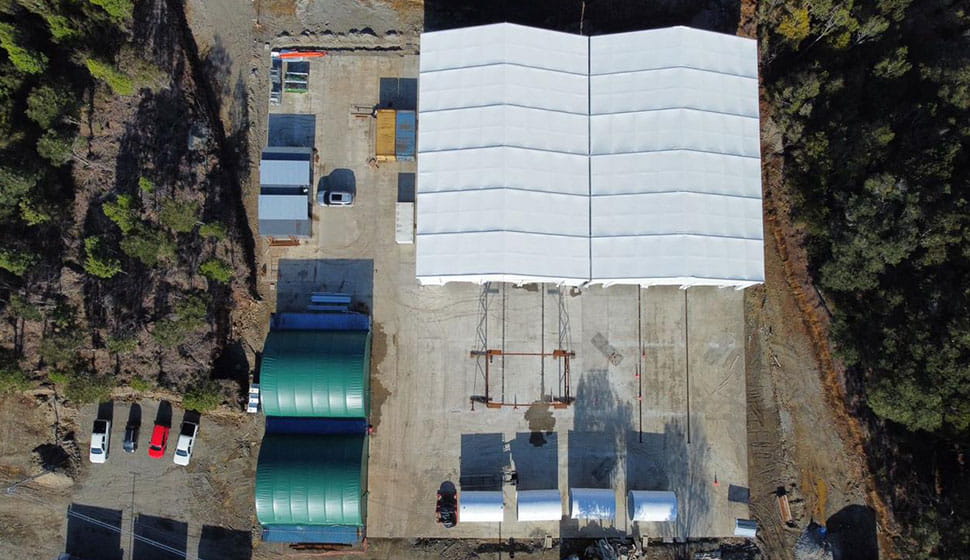

In an era where supply chain efficiency and agility are more important than ever before, businesses are constantly seeking solutions that can quickly adapt to the constantly changing demands.
Clear span temporary buildings have become one of the most flexible and cost-effective options for addressing modern warehousing challenges. These structures do not require internal support columns and are designed for rapid deployment, providing businesses with unparalleled flexibility while maintaining the durability and functionality required for permanent facilities.
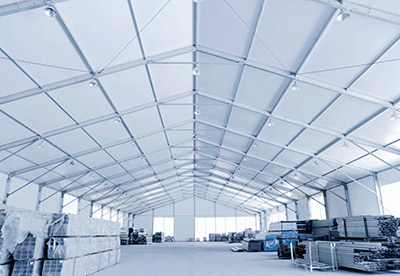
One of the most notable advantages of clear span temporary buildings is their completely open interior space. Traditional warehouses with internal columns would limit the configuration of shelves, reduce the available floor area, and complicate the movement of large equipment, such as forklifts or automated guided vehicles.
In contrast, column-free spaces allow operators to design layout schemes, maximize storage density, and simplify operation processes. Businesses can precisely configure the placement of shelves, pallet racks, or mechanical equipment as needed, without having to consider alternative solutions brought about by structural obstacles.
Another key advantage lies in their installation speed. Unlike traditional warehouses that may take months or even longer to build, clear span temporary buildings adopt modular design and prefabricated components, and can be assembled within days or weeks.
This rapid deployment capability is particularly important for enterprises facing sudden changes in demand. For instance, before the holiday sales peak season arrives, retail or e-commerce enterprises often need additional storage space to accommodate the increased inventory.

Clear span temporary buildings have a significant cost advantage, which is one of the important reasons for their wide adoption. They do not require extensive foundation works or relevant permits like permanent buildings, thereby reducing the initial investment.
Their modular structure design further reduces labor and construction costs. Clear span buildings use prefabricated components, which are produced in advance in factories and then transported to the site for direct assembly, eliminating a large number of on-site processing and complex construction steps.
Flexibility goes far beyond installation. Clear span temporary buildings have extremely high adaptability in structural design and can be expanded, reduced, or relocated relatively easily. If the company’s operational scope undergoes regional changes, these buildings can be moved accordingly without the need to build new warehouses at multiple locations.
Similarly, rapidly developing enterprises can seamlessly expand the length or width of buildings, thereby increasing storage capacity. This type of clear span structure not only meets current demands but also can easily adapt to future development, and is regarded as an ideal long-term solution for highly dynamic industries.
Modern clear span temporary warehouses are constructed with high-quality materials and can withstand harsh weather conditions, including heavy snow and strong winds. These structures typically employ high-strength aluminum alloy frames and industrial-grade tarpaulin materials, ensuring lightweight while maintaining stability and durability.
Meanwhile, modern temporary warehouses have also achieved professional configuration in terms of environmental control. Advanced insulation materials, HVAC systems and lighting equipment ensure that sensitive goods are properly protected. Whether it is for storing raw materials, finished products or temperature-controlled inventory, enterprises can rely on the reliability and performance of these buildings.
Clear span temporary buildings endow enterprises with the adaptability they need in today’s rapidly changing market. Their open interior design, quick installation, cost savings and scalability make them an ideal solution for enterprises seeking higher warehouse flexibility. Whether used for short-term storage, long-term warehousing, or transitional facilities during expansion, these buildings can offer reliable performance and unparalleled versatility.